

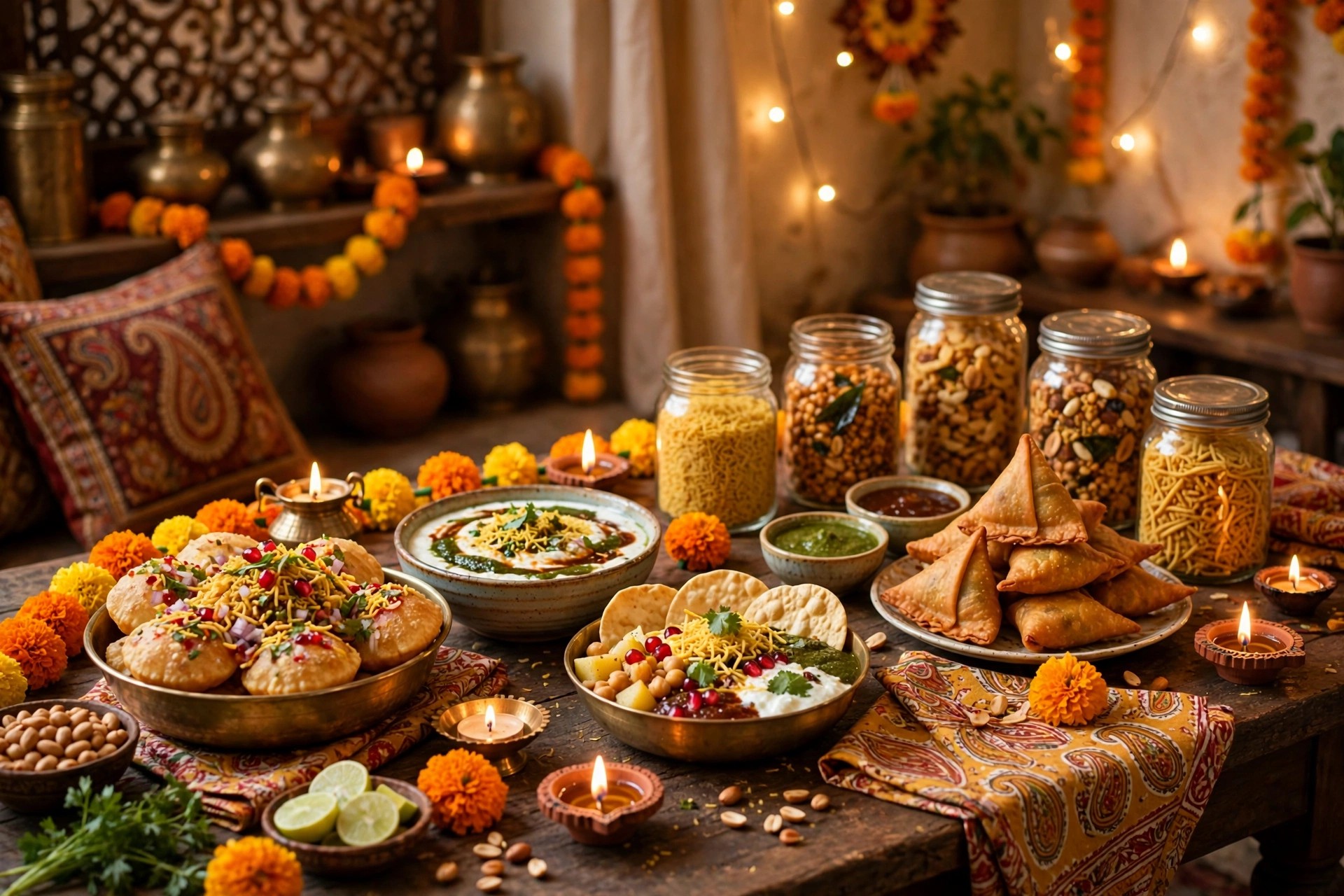
Diwali snacks are the part of the party guests remember first, and the part hosts stress about most. The sweets get photographed, the dinner gets praised, but it is the snack table that keeps people happy while the diyas are lit, the cards come out and the conversation finds its pace. Get the snacks wrong and guests hover awkwardly, or fill up on one heavy dish and skip everything else. Get them right and the evening runs itself.
This guide is built for a real Indian home party, not a restaurant menu. It gives you 15 Diwali party snacks recipes you can actually make ahead, in quantities that work for 10 to 15 guests, with clear storage times and the crispness tricks that most roundups skip. It also tells you what to serve when, how much to make, and which snacks to keep away from each other so nothing goes soft before the first guest arrives. If you are planning the full evening, pair this with our Diwali dinner menu ideas for guests and our Diwali card party ideas at home so the food, games and timing work as one plan.
The Snack Table Formula: How Much, and in What Order
Before you pick recipes, decide the shape of the table. A good Diwali snack table has four kinds of food, not fifteen versions of the same thing.
Something crunchy and dry: This is your namkeen base. It sits out all evening, needs no heating, and gives early guests something to eat the moment they arrive. Plan 60 to 80 grams per guest across all dry snacks combined.
Something fresh and tangy: Chaat, served in small cups or assembled to order. This is the star, but it does not wait well, so it needs a system, covered below.
Something warm and filling: Samosas, pakoras, cutlets or tikkis, served in batches. Plan 3 to 4 pieces per guest across all warm items, not 3 to 4 of each.
Something sweet to finish the snack round: Small ladoos, barfi bites or a mithai board. Keep portions tiny, because dinner or a full sweet spread usually follows. Our easy Diwali sweets recipes will help you pick sweets that pair with savoury snacks instead of competing with them.
Serve in this order in practice: dry snacks out first, chaat next, warm bites in two rounds, sweets last. Guests eat less, enjoy more, and you are not frying through the whole party.
Make-Ahead Dry Snacks: Cook Once, Serve All Week
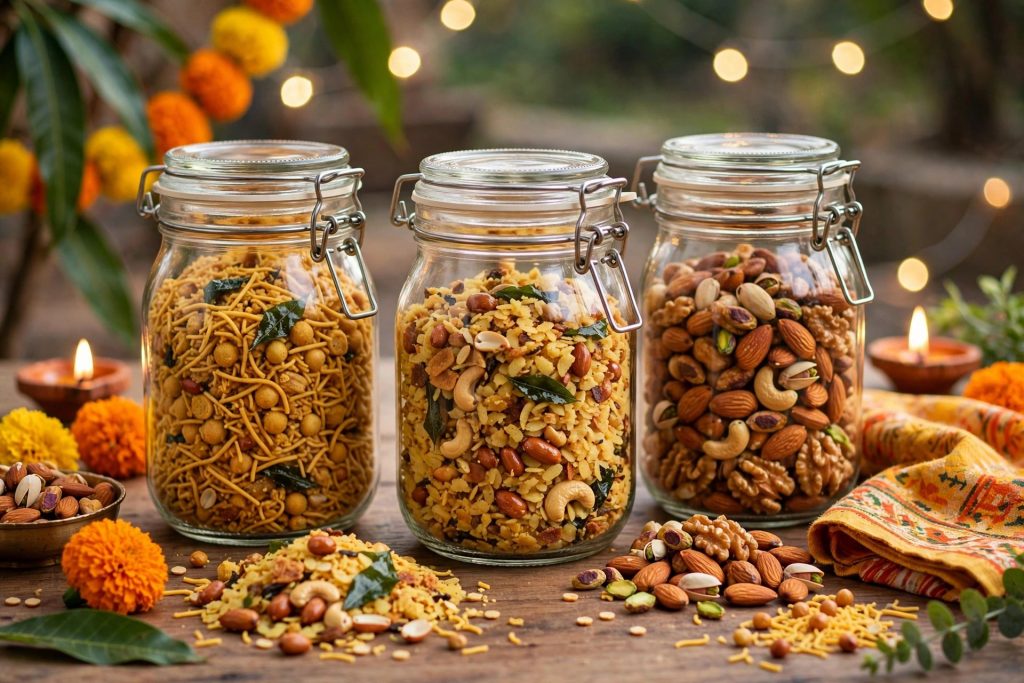
Dry snacks are where make-ahead planning pays off most. Make them 5 to 10 days before Diwali, cool them completely, and store them in airtight steel or glass jars. Warm snacks sealed too early steam themselves soft, which is the most common reason homemade namkeen disappoints.
1. Poha chivda
Roast thin poha with peanuts, roasted chana, curry leaves, mustard seeds and a little turmeric until crisp. It keeps 7 to 10 days at room temperature and is the safest dry snack for a mixed crowd, because it is light, not too spicy, and easy to eat standing up.
2. Chakli
Rice flour and besan chakli, fried until fully dry inside, keeps 7 to 10 days. The test is sound, not colour: a chakli that snaps cleanly is done, while one that bends is still damp inside and will soften in the jar. Bake a test batch first if you are new to chakli, because oven and air fryer versions dry out faster and need a shorter cook time.
3. Mathri and namak pare
These two are the work horses of a Diwali snack table. Mathri keeps 10 to 14 days, namak pare the same, and both travel well in gift boxes too. Roll namak pare evenly so they brown at the same rate, and prick mathri with a fork so it does not puff into a puri.
4. Roasted masala nuts and seeds
Almonds, cashews and makhana roasted with ghee, chaat masala and a pinch of black salt keep 2 weeks in an airtight jar. This is your premium-looking snack with almost no effort, and it is the one guests with smaller appetites reach for first. Keep nut snacks in a separate labelled bowl, because nut allergies are common and guests should never have to guess.
5. Sev and kara boondi mix
Buy good quality sev or make kara boondi at home, then mix with roasted peanuts and curry leaves just before serving. Do not mix sev into chaat until the last minute. Sev left in a bowl with chutney for an hour is no longer sev, it is a soft garnish.
Chaat and Fresh Bites: The Star of the Table
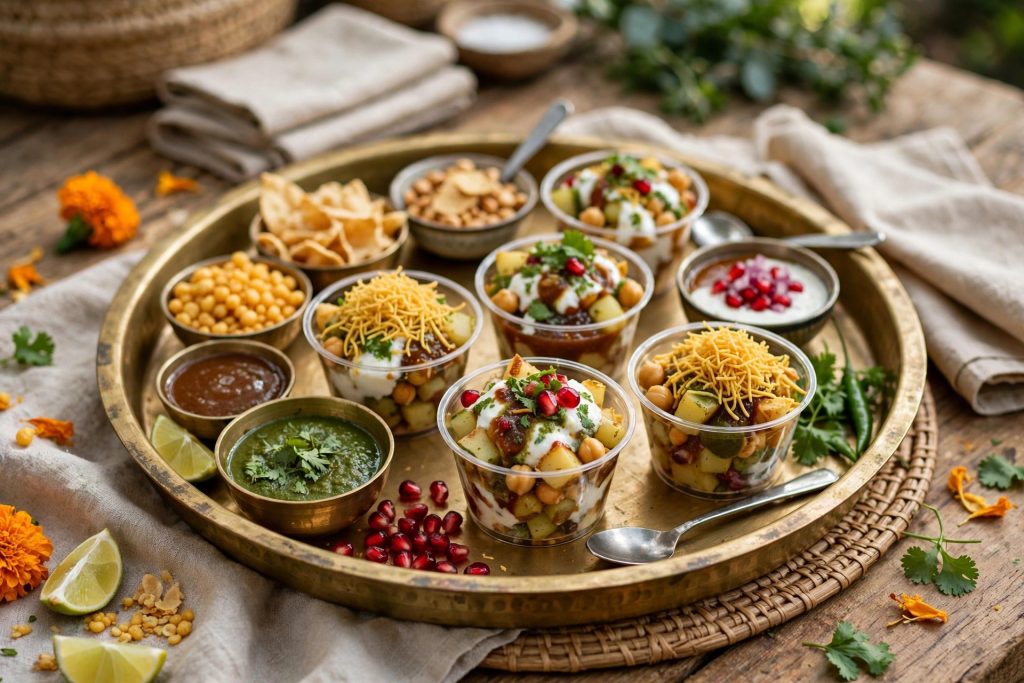
Chaat is where most Diwali parties go wrong, not because the recipe fails but because the timing fails. Chaat assembled an hour early is soggy chaat. The fix is a chaat station: keep every component separate, and assemble small cups to order, or in batches of 6 to 8 just before serving.
6. Dahi papdi chaat cups
Layer crushed papdi, boiled potato, chana, yoghurt, tamarind chutney and green chutney in small paper cups or shot glasses. Make the chutneys a day ahead, boil the potatoes and chana the same morning, and assemble only when guests are ready. One batch of chutney serves about 15 cups, so scale chutney, not papdi, if your guest list grows.
7. Samosa chaat
Crush one mini samosa per cup, add chole, yoghurt and chutneys, and finish with sev and coriander. This is the best use of samosas at a party, because a crushed samosa stays crisp under chutney for a few minutes longer than a whole samosa dipped in chutney does. Keep samosas warm in a low oven and crush to order.
8. Bhel puri, served dry until the last second
Keep puffed rice, sev, chopped onion, tomato, boiled potato and chutneys in separate bowls, and let guests mix their own, or mix one bowl at a time for 4 to 5 people. A full party-size bowl of bhel mixed in advance will be soft within 20 minutes, however good the recipe is.
9. Dahi ke kebab and paneer tikka bites
These are your warm, protein-rich bites, and they suit guests who do not eat fried snacks all evening. Dahi kebabs need a dry hung curd, or they will split in the pan. Paneer tikka can be marinated the night before and grilled or air fried in batches. Serve both with mint chutney, not with a sweet chutney that makes the whole plate taste like dessert.
10. Mini dhokla chaat
Steam dhokla the morning of the party, cut it into bite-size squares, and top with green chutney, sev and pomegranate. Dhokla chaat is lighter than samosa chaat, it suits older guests and children, and it is one of the few chaat items that still tastes good at room temperature for an hour.
Warm Bites in Batches: Fry Less, Serve Better
The mistake is frying everything before guests arrive. Fried food held for an hour goes soft, and the host spends the party in the kitchen. Fry in two rounds instead: one round as guests settle, one round halfway through the evening. Keep finished bites on a wire rack in a warm oven, never in a covered steel dabba, where steam collects.
11. Mini samosas
Mini samosas are better party food than full-size samosas, because guests can eat them in two bites while holding a glass. Make the filling dry, seal the edges well with a flour paste, and fry until deep golden. A wet filling is what makes samosas burst in oil, so cook potatoes and peas until no water remains.
12. Moong dal pakora and corn pakora
Pakoras are the fastest warm snack to scale, because the batter comes together in minutes. Keep the batter thick, rest it only 10 minutes, and fry small spoonfuls so they cook through. Corn pakora, with sweetcorn, onion and green chilli, is a good lighter option alongside heavier moong dal pakora.
13. Aloo tikki chaat
Shallow fry aloo tikkis ahead, then reheat them in the oven and top with chole and chutneys at serving time. This gives you a warm chaat without frying to order, and it is a good vegetarian main bite for guests who skip the heavier snacks.
14. Cheese corn balls and paneer fingers
These are the kid-friendly bites, and adults eat them first too. Roll them the day before, refrigerate covered, and fry or air fry in batches. Serve with a tomato chutney or a simple ketchup and mint chutney duo, and keep the count modest, because cheese bites fill guests up fast.
15. Namkeen snack board
End the planning with a board, not a recipe: small bowls of chivda, sev, kara boondi, roasted nuts and mathri, with a bowl of green chutney in the centre. A namkeen board looks generous, costs little, needs no heating, and covers you if a warm snack runs out or a guest arrives early. It is also the easiest snack idea to repeat for Bhai Dooj or a second party, because the jars are already full.
A Make-Ahead Timeline That Actually Works
- 10 to 7 days before: Make chivda, mathri, namak pare and roasted nuts. Store airtight, away from steam and sunlight.
- 3 days before: Make tamarind chutney and green chutney, refrigerate in clean jars. Make chakli if you have not already.
- 1 day before: Marinate paneer, make dhokla batter ingredients ready, roll cheese balls and samosas and refrigerate covered. Polish the serving bowls and plan the table layout.
- Party morning: Steam dhokla, boil potatoes and chana, chop onions and coriander, set out dry snacks in labelled bowls.
- 1 hour before guests arrive: Put dry snacks out, set up the chaat station with separate bowls, and start the first warm batch 15 minutes before the first guest is expected.
- During the party: Assemble chaat in small batches, fry warm bites in two rounds, and bring sweets out only after the snack round peaks. Refill small bowls often rather than putting out one huge bowl that goes stale.
Keeping Snacks Crisp, Safe and Kind to Every Guest
Crispness is a storage problem, not a recipe problem. Cool fried snacks completely on a rack before jarring, keep chutneys separate from dry snacks, and never store sweet and savoury snacks in the same jar, because sweets soften namkeen and namkeen makes sweets taste salty.
Food safety matters more at a festival party than on a normal day, because food sits out longer. Keep chaat and yoghurt-based snacks out for no more than 2 hours, refrigerate leftovers promptly, and do not reheat fried snacks more than once. If a snack has been out all evening in a warm room, throw it away rather than serving it the next day.
Label for allergies without making a fuss: one small card per bowl that says “contains nuts”, “contains dairy” or “gluten free” is enough. Keep at least two snacks that are naturally gluten free, such as roasted nuts and chivda made without wheat, and at least one snack without dairy, such as namak pare or roasted chana, so no guest is left with only sweets.
For children, keep spice low in at least one warm bite and one chaat, and keep whole nuts and hard namkeen out of reach of very young children. For older guests, keep seating near the snack table, small plates rather than large thalis, and cups rather than large bowls for chaat, because both are easier to hold.
FAQ
How many Diwali snacks should I make for 15 guests?
Plan 4 snack types, not 15 separate dishes: one dry namkeen mix, one chaat, one warm bite and one sweet bite. In quantity, that is about 60 to 80 grams of dry snacks per guest, 3 to 4 warm pieces per guest in total, and 1 small chaat cup per guest, with a second round for guests who want more.
Which Diwali snacks can I make a week ahead?
Chivda, mathri, namak pare, chakli and roasted nuts all keep 7 to 14 days in airtight jars at room temperature, provided they are cooled completely before sealing. Chutneys keep 3 to 4 days refrigerated. Chaat, dhokla and pakoras are same-day foods.
How do I keep samosas and pakoras crisp at a party?
Fry in small batches, drain on a wire rack, and hold in a warm oven with the door slightly open, never in a covered container. Serve within 30 minutes of frying, and fry a second batch halfway through the party instead of frying everything at the start.
What are good no-fry Diwali party snacks?
Roasted nuts and makhana, chivda, a namkeen board, dhokla chaat, dahi papdi cups made with baked papdi, and a fruit chaat with chaat masala and lemon. Air fryer versions of samosas, pakoras and cheese balls also work well if they are tested once before the party.
Can I serve chaat if guests arrive at different times?
Yes, and a chaat station is the best way to do it. Keep chutneys, yoghurt, papdi, sev and toppings in separate bowls, and assemble cups to order in batches of 6 to 8. Guests who arrive late still get crisp chaat, and you are not stuck assembling food for an hour.
What snacks suit guests who do not eat spicy food?
Dhokla chaat with mild chutney, roasted nuts without chilli, mathri, paneer tikka with a mild marinade, and cheese corn balls are all good low-spice options. Keep green chutney separate so guests can choose their own heat level.
Conclusion
A Diwali snack table does not need fifteen dishes, it needs the right four kinds of food, made ahead where possible and finished at the last minute where it matters. Dry namkeen covers the early hour, chaat gives the party its flavour, warm bites in two rounds keep the table alive, and a small sweet finish closes the snack round without spoiling dinner. Plan quantities for your real guest list, keep chutneys separate from crisp things, label for allergies, and fry less than you think you need, because a second fresh batch always beats a large stale one. Do that, and your snacks will do what Diwali food is meant to do: keep everyone together, talking, and reaching for one more bite, while you actually enjoy your own party.
