

Introduction
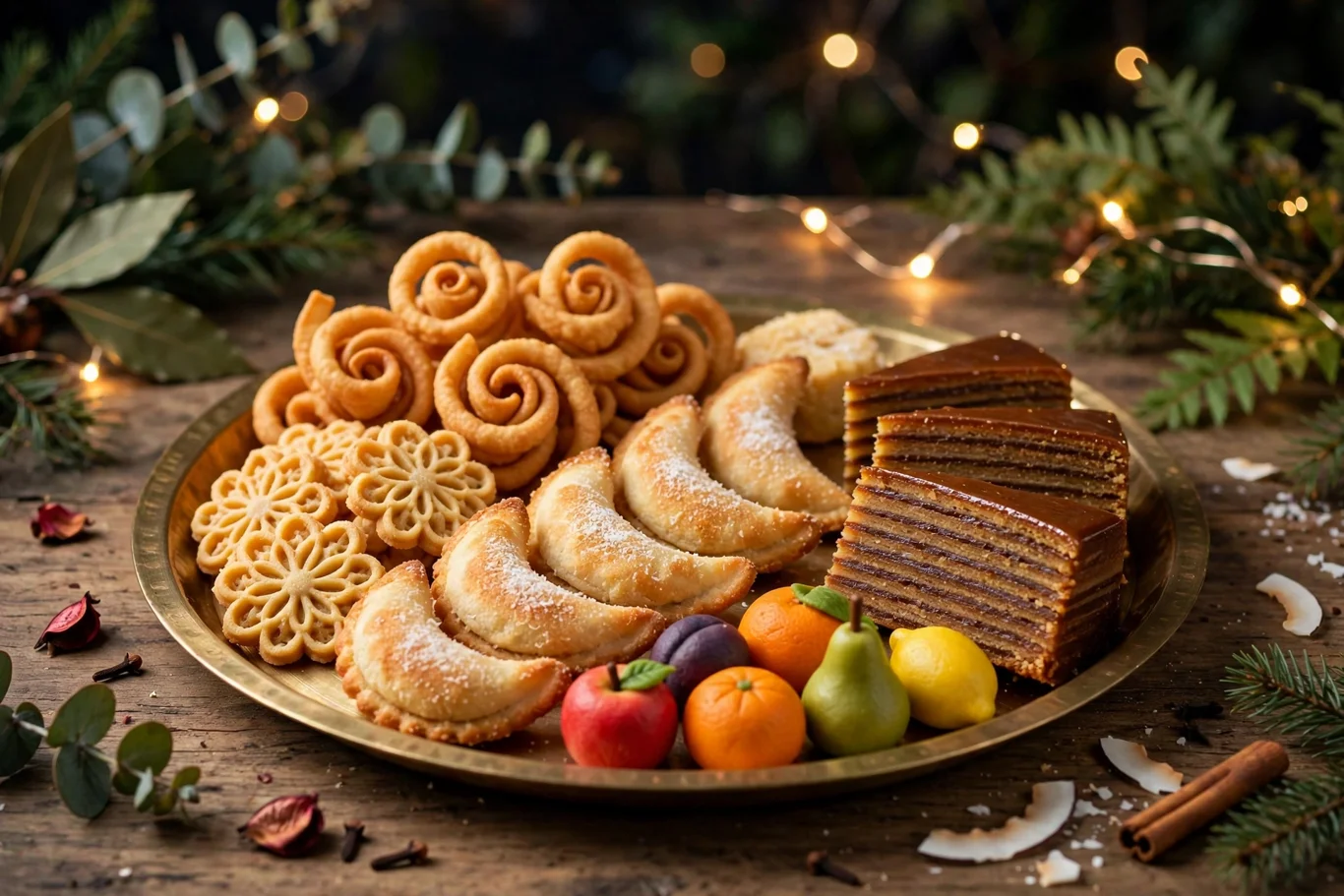
In Goa and Mangalore, Christmas does not begin with the tree or the lights. It begins in the kitchen, a week or two before the festival, when families start making kuswar: the platter of homemade sweets and savoury snacks that is shared with neighbours, friends, and relatives through the whole Christmas season. These Christmas sweets recipes from India are a tradition more than a century old, brought by Portuguese influence and made entirely Indian with coconut, jaggery, cardamom, and cashew.
The good news is that you do not need to be Goan, or Catholic, or an expert cook to make kuswar at home. Most of these sweets use the same simple dough of maida, coconut milk, and sugar, and the same technique of shaping, frying, and glazing. Once you learn the base, you can make half the platter from one batch of dough.
This guide gives you 12 Christmas sweets recipes from India, each with ingredients, a simple method, and storage notes. Pick three or four for your first kuswar, or make the full dozen over a weekend with the family. Christmas falls on Friday, 25 December 2026, so the best time to start is the second week of December: most of these sweets keep for two to three weeks in an airtight tin.
What Is Kuswar?
Kuswar is the Konkani word for the Christmas platter of sweets and snacks prepared in Goan and Mangalorean Catholic homes. Families begin making it in early December, and the sweets are packed into tins and shared as a consuada, a gift of Christmas goodies, with everyone who visits during the season. The classic kuswar includes kulkuls, rose cookies, neureos, bebinca, dodol, bolinhas, and marzipan, along with savoury items like chaklis and banana chips.
The tradition survives because it is practical. Every sweet on the platter keeps well without a fridge, travels well in a tin, and tastes better after a day or two. It is also a family project: one person shapes, one fries, and the children glaze. If you have never made kuswar, start with kulkuls and rose cookies this year, and add one new sweet each Christmas.
1. Kulkuls, the Sugar-Glazed Curls
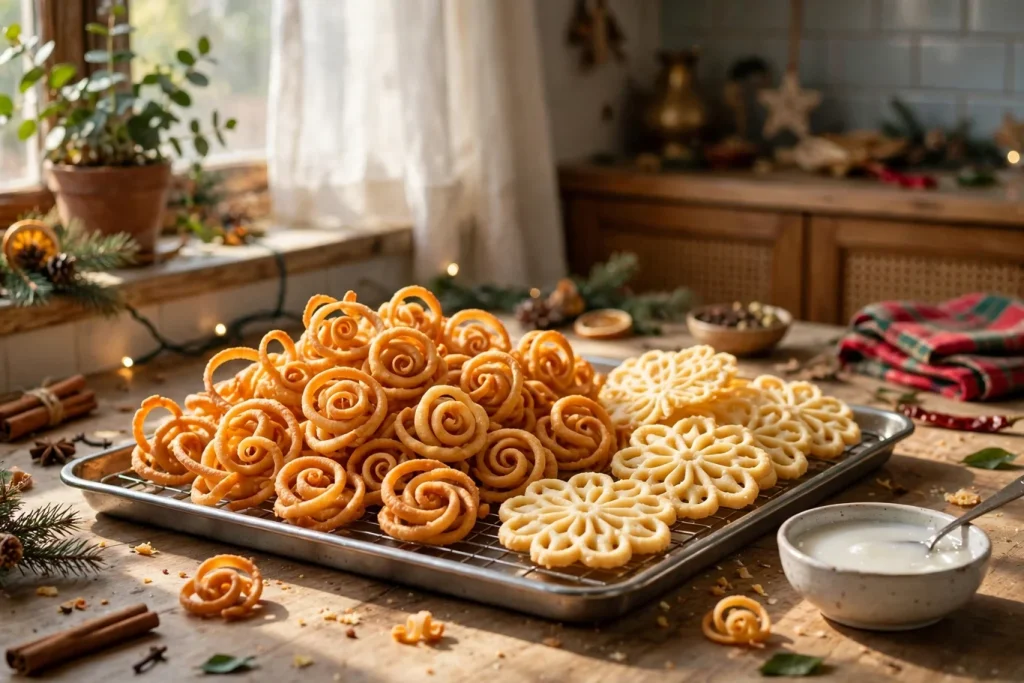
Kulkuls, also called kalkals or kidiyo, are the most loved sweet on the kuswar platter: tiny ridged curls of dough, fried until crisp and coated in a thin sugar glaze. They look fiddly, but the shaping is easy once you try two or three.
Ingredients for about 50 pieces: 2 cups maida, 2 tablespoons fine rava, 2 tablespoons powdered sugar, a quarter teaspoon salt, 2 tablespoons softened ghee, 1 egg, about half a cup of thick coconut milk, and oil for deep frying. For the glaze: half a cup of sugar, a quarter cup of water, and a quarter teaspoon of cardamom powder.
Mix the flour, rava, sugar, and salt. Rub in the ghee until the mixture looks like breadcrumbs. Add the egg and knead in the coconut milk a little at a time until you have a smooth, firm dough. Cover and rest for 20 minutes. Pinch off a pea-sized ball, press it flat on the back of a greased fork, and roll it up into a ridged curl. Fry in medium-hot oil until light golden, about 4 to 5 minutes. Cool completely, then toss briefly in a one-thread sugar syrup and spread on a tray to dry. Kulkuls keep for three weeks in an airtight tin.
2. Rose Cookies, or Achappam
Rose cookies are crisp, flower-shaped wafers made with a special mould, and they are the prettiest sweet on the platter. Keralites call them achappam, and they appear on Christmas tables across South India as well as in Goa.
Ingredients for about 30 pieces: 1 cup rice flour, 2 tablespoons maida, a quarter cup sugar, a pinch of salt, 1 egg, about three quarters of a cup of coconut milk, 1 teaspoon sesame seeds, and a quarter teaspoon of cardamom powder. You will need a rose cookie mould, sold at most Indian grocery stores and online for about Rs 200 to Rs 400.
Whisk the flours, sugar, salt, and cardamom. Beat in the egg, then add the coconut milk gradually until the batter is as thick as pancake batter. Stir in the sesame seeds and rest for 30 minutes. Heat oil in a kadhai. Dip the hot mould into the batter, coating it thinly but not covering the top, then plunge the mould into the oil. The cookie will release from the mould in a few seconds. Fry until golden and crisp, then drain on paper. Rose cookies keep for two weeks in an airtight tin, and they travel well, which is why they are a favourite for gifting.
3. Neureos, the Coconut and Jaggery Parcels
Neureos, also called nevri or karanji, are small half-moon pastries stuffed with sweetened coconut and dry fruits, then fried until crisp. They are the most filling sweet on the platter and the one children reach for first.
Ingredients for about 25 pieces: 2 cups maida, 2 tablespoons ghee, a pinch of salt, and water to knead. For the filling: 1 cup grated fresh coconut, half a cup of jaggery, 2 tablespoons chopped cashews, 1 tablespoon raisins, and half a teaspoon of cardamom powder.
Knead the maida, ghee, and salt into a firm dough and rest for 30 minutes. Cook the coconut and jaggery together on a low flame until the mixture thickens, then stir in the cashews, raisins, and cardamom and cool. Roll the dough into small circles, place a spoonful of filling in the centre, fold into a half moon, and seal the edges firmly with a fork. Fry in medium-hot oil until golden brown. Neureos keep for 10 to 12 days in an airtight tin. For an eggless version, this recipe needs no change at all, since the dough uses no egg.
4. Bebinca, the Seven-Layer Goan Cake
Bebinca is Goa’s most famous dessert: a rich, dense cake built from seven thin layers of coconut milk, egg yolk, sugar, and ghee, baked one layer at a time. It is the centrepiece of the kuswar platter and the sweet most often served to honoured guests.
Ingredients: 1 cup coconut milk, 10 egg yolks, 1 cup sugar, 2 tablespoons ghee, 4 tablespoons maida, a pinch of salt, and half a teaspoon of nutmeg powder. Whisk the yolks and sugar until pale, then add the coconut milk, maida, salt, and nutmeg. Grease a round cake tin and pour in a thin layer of batter, about 3 to 4 tablespoons. Grill or bake until set and lightly golden, brush with ghee, and pour the next layer. Repeat until all seven layers are done. Cool completely, then slice into thin wedges.
Bebinca takes patience, about 90 minutes of layering, but each layer takes only a few minutes, so it is a good project to do while listening to Christmas carols. It keeps for a week in the fridge and two weeks in the freezer, and it tastes better on the second day.
5. Dodol, the Coconut Toffee
Dodol is a soft, chewy toffee made from coconut milk, jaggery, and rice flour, cut into diamonds and wrapped in butter paper. It is dark, glossy, and deeply flavoured, and a little goes a long way.
Ingredients: 2 cups thick coconut milk, 1 cup grated jaggery, half a cup of rice flour, 2 tablespoons ghee, half a cup of chopped cashews, and a pinch of salt. Mix the coconut milk and rice flour until smooth, then cook on a low flame with the jaggery, stirring constantly. After 30 to 40 minutes the mixture will thicken and leave the sides of the pan. Stir in the ghee and cashews, spread on a greased tray, and cool. Cut into diamonds and wrap each piece in butter paper. Dodol keeps for two weeks at room temperature.
The stirring is the hard part, so take turns with a family member. The result is worth it: a sweet that tastes of coconut and caramel and keeps beautifully in a gift tin.
6. Bolinhas, the Coconut Macaroon Cookies
Bolinhas, also called bolinhas de coco, are soft coconut cookies, crisp outside and chewy inside, made from desiccated coconut, semolina, and sugar. They are one of the easiest kuswar sweets and a good choice for beginners.
Ingredients for about 20 cookies: 2 cups desiccated coconut, half a cup of fine rava, half a cup of sugar, 2 eggs, 1 teaspoon vanilla essence, and a pinch of salt. Mix everything into a soft dough and rest for 15 minutes. Shape into small balls, flatten slightly, and bake at 180 degrees Celsius for 15 to 18 minutes until the edges are golden. Cool on a rack before storing. Bolinhas keep for 10 days in an airtight tin.
For an eggless version, replace the eggs with half a cup of condensed milk and reduce the sugar by 2 tablespoons. The cookies will be slightly softer but just as delicious.
7. Marzipan Fruits and Sweets
Marzipan is a sweet almond paste that Goan families shape into tiny fruits, vegetables, and animals, then paint with food colour. The little marzipan mangoes, bananas, and cashews are the most delightful sight on the kuswar platter, and children love them.
Ingredients: 2 cups almond powder, 1 cup powdered sugar, 1 egg white, half a teaspoon of almond essence, and food colours in red, yellow, and green. Knead the almond powder, sugar, egg white, and essence into a smooth dough. Divide into small portions, colour each one, and shape into tiny fruits. Use a clove as the stem of an apple, or a toothpick to mark the lines on a banana. Let the pieces dry overnight, then pack carefully.
Ready-made marzipan is sold in Goan bakeries and online for about Rs 400 to Rs 600 a kilo if you prefer to buy it and shape it yourself. Marzipan keeps for two weeks in an airtight box in a cool place.
8. Christmas Plum Cake, the Classic
No kuswar platter is complete without plum cake, and no Indian Christmas is complete without the smell of it baking. The fruit mix is soaked for days or weeks: raisins, sultanas, currants, candied peel, glace cherries, dates, figs, cashews, almonds, and walnuts, with Indian twists like candied amla, dried pineapple, and jaggery instead of some brown sugar.
The full recipe, with the soaking schedule, the spice mix, and the eggless version, is in our detailed Christmas plum cake recipe for Indian homes. As a summary: soak 2 cups of mixed dried fruit in orange juice or rum for at least 3 days, cream 1 cup of butter with 1 cup of brown sugar, add 3 eggs one at a time, fold in 2 cups of maida with baking powder and mixed spice, stir in the fruit, and bake at 160 degrees Celsius for 90 minutes. Brush with a little rum or orange juice while warm, and rest for 2 days before cutting. Plum cake keeps for a month in an airtight tin and improves with age.
9. Chana Doce, the Gram and Coconut Sweet
Chana doce is a soft, fudge-like sweet made from chana dal, coconut, and sugar, and it is a favourite in Goan Catholic homes. It is less famous than kulkuls, which is a shame, because it is one of the easiest kuswar sweets to make.
Ingredients: 1 cup chana dal, 1 cup grated coconut, 1 cup sugar, 2 tablespoons ghee, half a teaspoon of cardamom powder, and 2 tablespoons chopped cashews. Soak the chana dal for 4 hours, then pressure cook until soft and grind to a smooth paste. Cook the paste with the coconut and sugar on a low flame, stirring constantly, until the mixture thickens and leaves the sides of the pan. Stir in the ghee, cardamom, and cashews, spread on a greased tray, and cut into squares when cool. Chana doce keeps for 10 days in an airtight tin.
10. Carambolas, the Crisp Sugar Squares
Carambolas are made from the same dough as kulkuls, but shaped into crisp, flat squares instead of curls, and they are traditionally the first shape fried from every batch. The dough is rolled thin, cut into squares with a serrated wheel, and fried until pale golden.
Use the kulkul dough from recipe 1: 2 cups maida, rava, sugar, egg, and coconut milk. Roll the dough thin, cut into 1-inch squares, and fry in medium-hot oil until crisp. Dust with powdered sugar while warm, or coat in the same one-thread sugar syrup used for kulkuls. Carambolas keep for three weeks in an airtight tin and are the crunchiest sweet on the platter, so pack them on top where they will not be crushed.
If you make kulkuls and carambolas together from one batch of dough, you get two sweets for the effort of one, which is how Goan families fill their tins so efficiently.
11. Coconut Macaroons
Coconut macaroons are a simple drop cookie: desiccated coconut, egg whites, and sugar, baked until golden at the edges. They are gluten-free by nature, take 10 minutes to mix, and disappear fast.
Ingredients for about 20 macaroons: 2 cups desiccated coconut, 2 egg whites, half a cup of sugar, 1 teaspoon vanilla essence, and a pinch of salt. Whisk the egg whites and sugar until frothy, fold in the coconut and vanilla, and drop spoonfuls onto a lined baking tray. Bake at 170 degrees Celsius for 15 minutes until the edges are golden. Cool completely before storing. Macaroons keep for a week in an airtight tin.
Dip the base of each cooled macaroon in melted dark chocolate for a festive finish. The chocolate sets in 20 minutes and makes the macaroons look like they came from a bakery.
12. Jaggery Fruit Cake, the Eggless Favourite
Many Indian families prefer an eggless Christmas cake, and jaggery makes it special. This cake uses jaggery instead of refined sugar, which gives it a deep caramel flavour and a dark, rich colour.
Ingredients: 2 cups maida, 1 cup grated jaggery, 1 cup mixed dried fruit soaked overnight in orange juice, half a cup of curd, half a cup of oil, 1 teaspoon baking soda, 1 teaspoon mixed spice, and half a cup of chopped walnuts. Dissolve the jaggery in half a cup of warm water and cool. Whisk the curd, oil, and jaggery syrup together, then fold in the flour, baking soda, spice, fruit, and walnuts. Bake at 170 degrees Celsius for 50 to 60 minutes. Cool completely before slicing. The cake keeps for 10 days in an airtight tin and tastes better on the second day.
This is the cake to make if you have vegetarian guests, since it uses no egg at all, and the jaggery gives it a flavour that refined sugar cannot match.
Your Make-Ahead Kuswar Timeline
The secret of kuswar is the timeline. Start in the second week of December, and make two sweets per session, not all twelve at once. In week one, soak the fruit for the plum cake and the jaggery fruit cake, and make the kulkuls, carambolas, and rose cookies, which keep for two to three weeks. In week two, make the neureos, dodol, chana doce, and bolinhas, which keep for about 10 days. Make the bebinca and the cakes last, from 22 December onwards, so they are at their best on Christmas Day. Shape the marzipan fruits on 23 December and let them dry overnight.
Pack each sweet in its own airtight tin or in separate compartments, with butter paper between layers, so the crisp sweets stay crisp and the soft ones stay soft. Label each tin with the sweet name and the date it was made.
How to Store and Gift Christmas Sweets
Storage is simple if you follow three rules. First, cool every sweet completely before packing, or trapped steam will make it soggy. Second, use airtight tins, not plastic bags, and keep the tins in a cool, dry place away from sunlight. Third, do not mix crisp sweets and soft sweets in the same tin, or the crisp ones will absorb moisture.
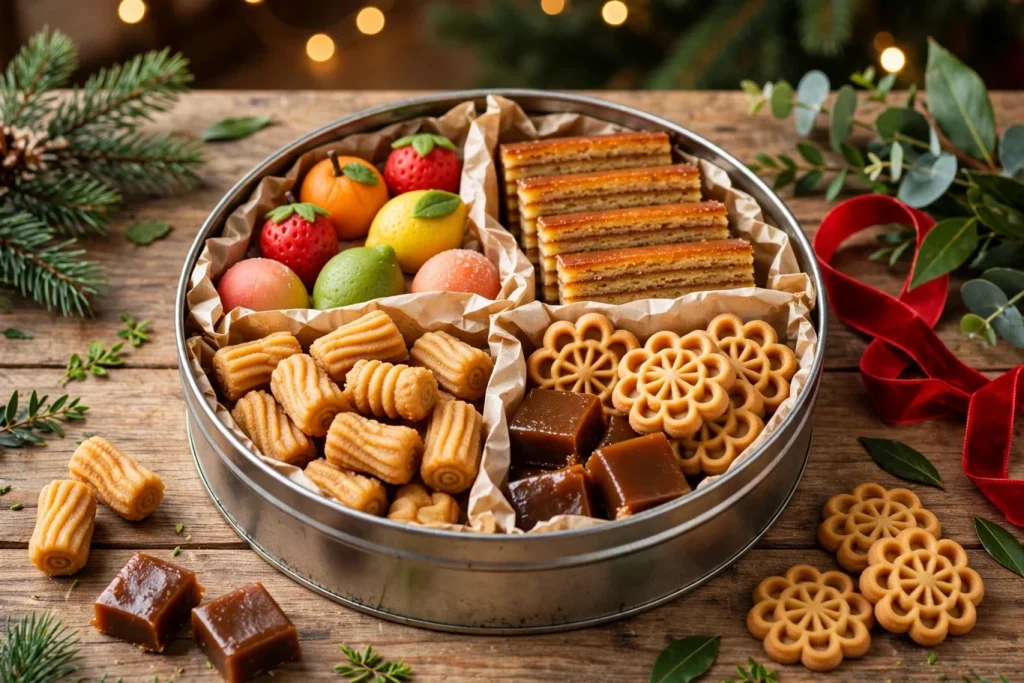
For gifting, pack a small selection of four or five sweets in a steel dabba or a biscuit tin lined with butter paper, add a handwritten card, and tie a ribbon around it. A kuswar gift tin costs about Rs 150 to Rs 300 to put together and means far more than a shop-bought box. If you want more festive baking ideas for the season, our Christmas dessert recipes collection has puddings, trifles, and no-bake options, and our Christmas cookies recipes are perfect for baking with children.
Frequently Asked Questions
How far in advance can I make Christmas sweets?
Most kuswar sweets keep for two to three weeks in an airtight tin, so you can start in the second week of December. Kulkuls, carambolas, and rose cookies keep the longest. Bebinca and cakes are best made in the last few days before Christmas.
What sweets are in a traditional Goan kuswar?
The classic kuswar includes kulkuls, rose cookies, neureos, bebinca, dodol, bolinhas, marzipan, plum cake, and chana doce, along with savoury items like chaklis and banana chips. Families usually make four or five of these, not all of them.
Can I make kuswar sweets without eggs?
Yes. Neureos, chana doce, dodol, and the jaggery fruit cake in this guide use no eggs at all. For kulkuls, replace the egg with 2 tablespoons of curd. For bolinhas, use condensed milk instead of egg. The texture changes slightly, but the taste stays delicious.
Where do I buy a rose cookie mould in India?
Rose cookie moulds, also called achappam moulds, are sold at most Indian grocery stores, utensil shops, and online for about Rs 200 to Rs 400. Stainless steel moulds last longer than aluminium ones and are easier to clean.
How do I keep fried sweets crisp in humid weather?
Cool them completely on a rack before packing, pack them only in airtight tins, and add a small pouch of uncooked rice wrapped in muslin to absorb moisture. Do not open the tin in a steamy kitchen, and never store fried sweets in the fridge, which makes them soggy.
Conclusion
Making Christmas sweets at home is slower than buying a box, and that is exactly the point. The afternoon spent shaping kulkuls with your children, the smell of coconut and jaggery filling the house, and the tin of sweets carried to a neighbour’s door are the real Christmas tradition. Start with three or four recipes from this list, follow the make-ahead timeline, and let the platter grow by one sweet each year. Your kuswar will taste better than anything from a shop, because it was made by hand, in your kitchen, for people you love.
