

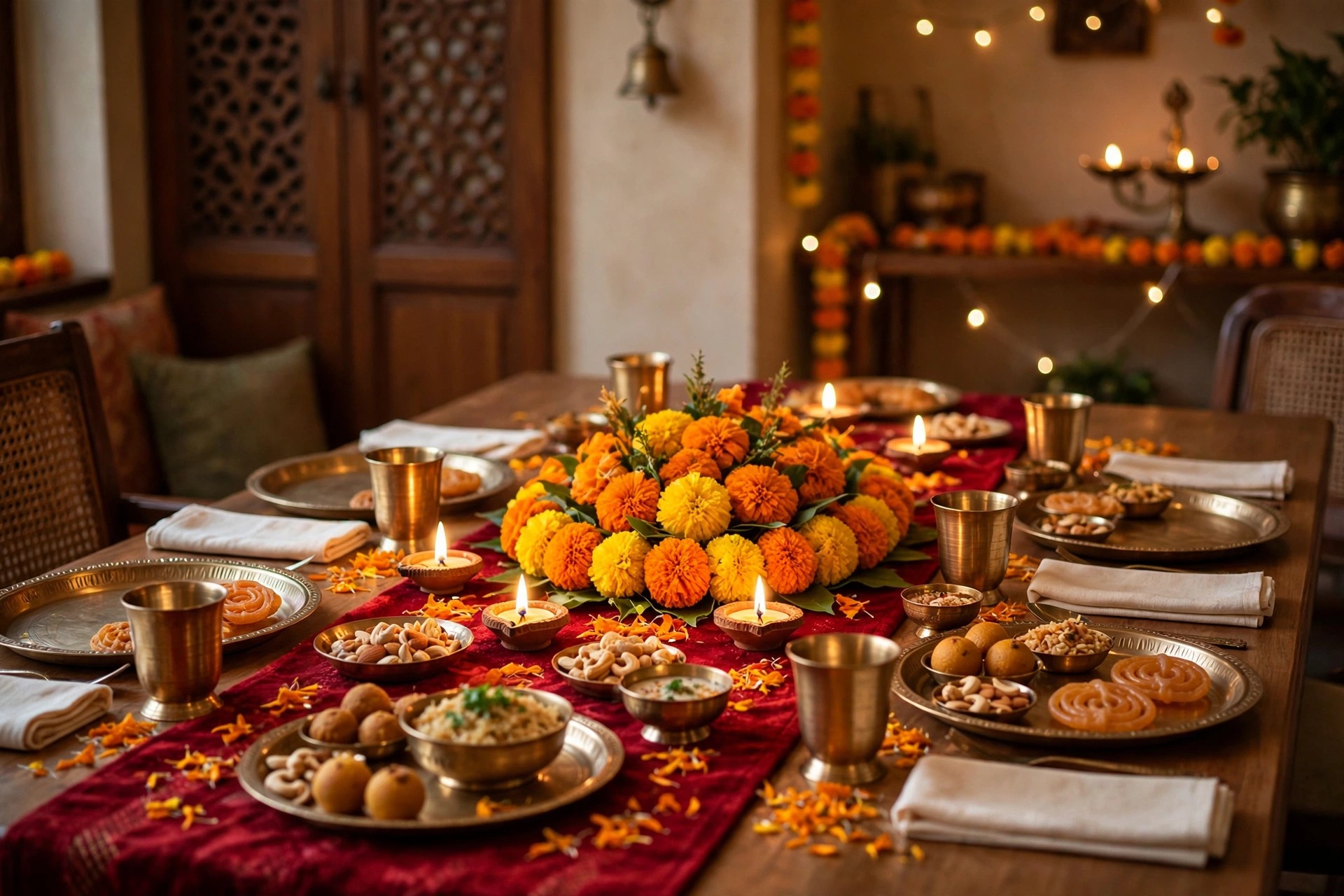
The dining table is where Diwali turns from decoration into celebration. Guests may admire the toran at the door and the lights in the living room, but they spend the longest, happiest part of the evening at the table, passing food, telling stories and reaching for sweets. A table that looks beautiful in a photograph but blocks conversation, crowds the plates or puts flames too close to fabric has failed at its real job.
This guide shows how to decorate a Diwali dining table for Indian homes in a way that is both festive and practical. It covers the one rule that matters most, centrepieces that stay low, runners and colour palettes that work with the food, brass and marigolds used with restraint, lighting at three heights, and seating plans for tables of 4, 6 and 8. It also gives budgets, because a beautiful table should not need a shopping trip to a luxury store. If you are decorating the rest of the house too, our Diwali living room decoration ideas and our Diwali pooja room decoration ideas will help you carry the same colours through every room, and our Diwali dinner menu ideas for guests will help you plan food that fits the table you have styled.
The One Rule: Guests Must See Each Other
Every other decision follows from this rule. A centrepiece taller than about 25 cm blocks eye contact across the table. A runner that hangs too low catches on chairs. A forest of diyas in the middle leaves no room for serving bowls. Before you buy anything, sit at your own table, look across it, and mark the space that must stay clear: the centre strip, no wider than one third of the table width, and low enough that you can see the person opposite you over it.
That rule also decides your table size plan. A 4-seat table can take one low centrepiece and one pair of small diyas. A 6-seat table can take a longer centrepiece, or two smaller ones with a gap for serving dishes. An 8-seat table needs either a long low runner of flowers and lights, or two matching centrepieces, one for each half of the table, so no guest sits in front of a blank stretch. Whatever the size, leave at least 60 cm of width per place setting, or elbows, plates and glasses will collide all evening.
Start With a Palette, Not a Shopping List
Diwali tables look best in two main colours plus gold, not in every bright colour at once. Pick your palette first, then buy or reuse items to match it.
- Classic marigold and deep red: Orange marigolds, a deep red or maroon runner, brass diyas and gold cutlery. This is the warmest, most traditional look, and it photographs beautifully in candlelight.
- Pink and gold: Pink roses or carnations, a blush or gold runner, brass or gold-toned plates. This suits modern flats and lighter wood tables, and it feels festive without being loud.
- Green and gold: Mango leaves, green silk or cotton runner, brass urlis and white flowers. This is calm, elegant and easy to carry into the pooja room as well.
- White, gold and one accent: White tablecloth, gold runner, and one strong accent colour in flowers, such as orange or magenta. This is the best choice if your dining chairs or crockery are already patterned, because the table does not compete with them.
Once the palette is set, repeat it in three places only: the runner, the centrepiece and the napkins or place cards. Repeating the same colour in every single item, from glasses to chair covers, looks busy rather than festive.
Runners, Cloths and the Base Layer
The base layer sets the tone and protects the table, so choose it for size first and colour second. Measure your table before you shop: a tablecloth looks best with a drop of 20 to 25 cm on each side, and a runner should end about 15 cm short of each end of the table, so it does not catch on chairs or get pulled when someone stands up.
A plain white or cream cloth with a festive runner is more flexible than a fully patterned cloth, because you can change the runner next year and get a new look for almost no cost. An old silk dupatta or a cotton saree border makes a beautiful runner, and it is a good way to reuse fabric you already own. If you use a dupatta, iron it, fold it to the right width, and pin or tape the underside so it does not slide when serving bowls are passed.
For a round table, skip a long runner and use a round cloth with a circular centrepiece tray instead. For a glass table, use placemats rather than a full cloth, because a cloth on glass slides and hides the table, while placemats frame each place setting cleanly.
Keep the base layer practical: a table protector or an old cotton sheet under a good cloth saves the table from hot dishes and spilled chutney, and a runner in a washable fabric is a better choice than a delicate embroidered one if children will be at the table.
Centrepieces That Stay Low and Leave Room for Food
The best Diwali centrepiece is a tray, not a tower. A tray contains the decoration, protects the table, and can be lifted away in seconds if you need more room for serving dishes.
1. Brass urli with floating flowers
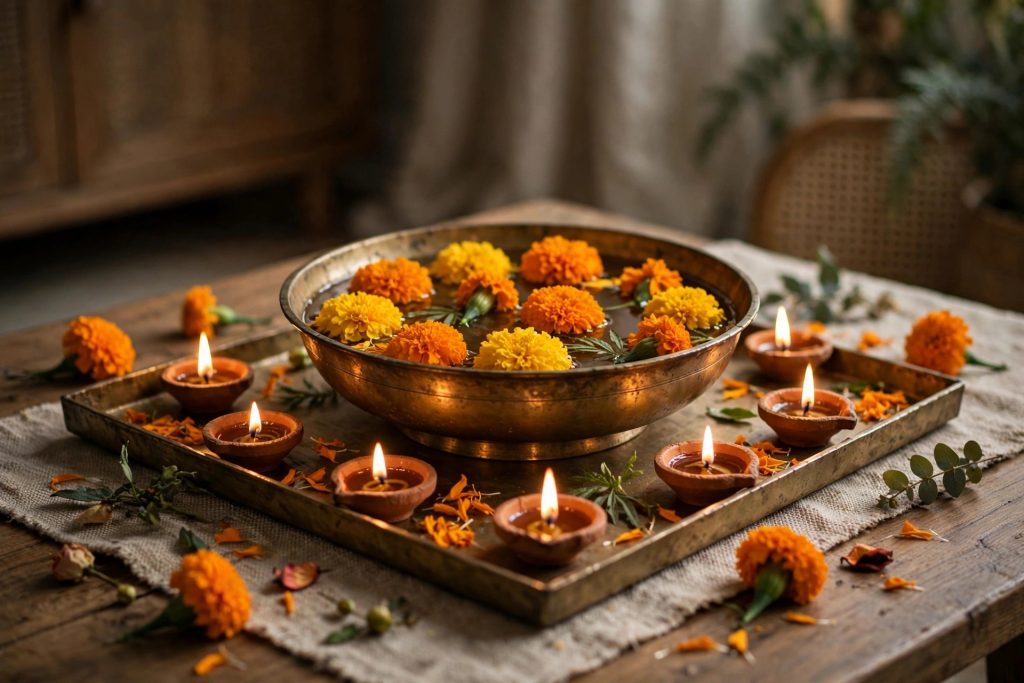
Fill a wide brass urli or a shallow bowl with water, float marigold petals and a few rose petals, and add two or three floating diyas or LED tealights. This is the classic Diwali centrepiece for a reason: it is low, it reflects light beautifully, and it can be made in five minutes. Keep the urli to one side of centre on a long table, so serving dishes have room, and place a folded towel under it to catch splashes.
2. Marigold and diya runner
Lay a line of loose marigold flowers down the centre of the runner, with small diyas or LED tealights spaced between them in odd numbers: three, five or seven. This works best on a 6 or 8 seat table, where the line can run the full length without blocking plates. Use LED diyas where children will reach across the table, and real diyas only where an adult can watch them.
3. Fruit and flower centrepiece
Pile oranges, pomegranates and a few lemons in a brass bowl, tuck marigolds between them, and add one small diya on a plate beside the bowl. This centrepiece doubles as a snack and a conversation piece, it costs little, and it suits a family lunch better than a formal dinner, because guests can help themselves.
4. Candle cluster on a tray
Group candles of different heights on a brass or wooden tray, with a few flower petals scattered around the base. This is the most modern look, and it works well if you prefer candles to diyas. Keep the tallest candle below eye level when seated, keep a plate under every candle, and never place a candle directly on fabric.
Brass, Plates and the Details Guests Notice
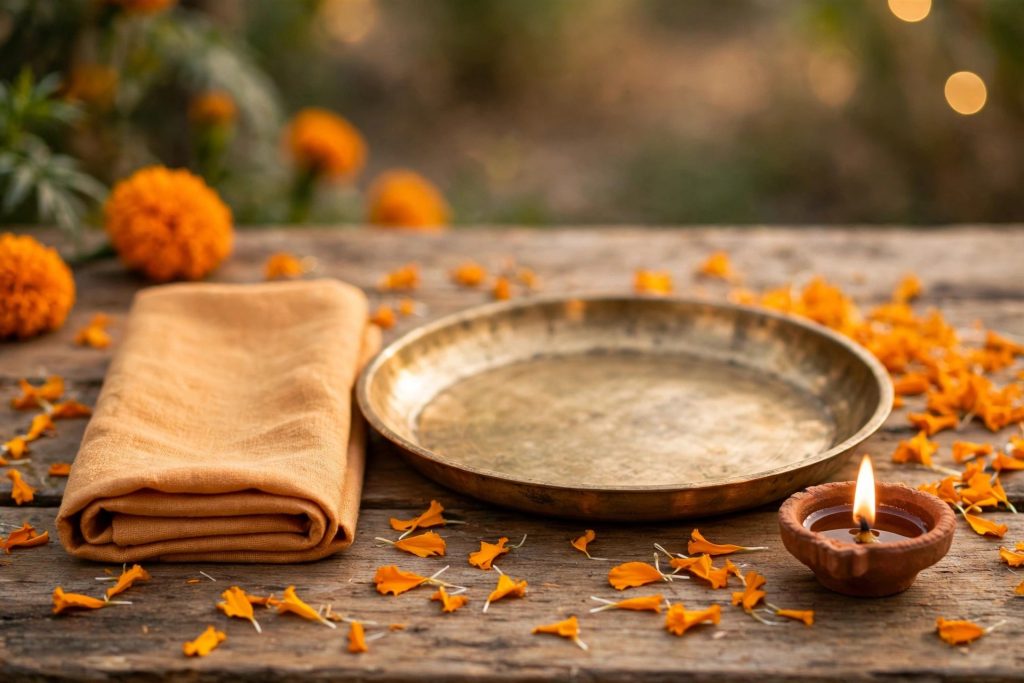
You do not need a full brass dinner set to get the Diwali effect. One good brass piece for every two place settings is plenty: a brass thali as a mithai platter, small katoris for dry fruit and namkeen, a lota as a vase for a few marigolds, or a brass diya stand at each end of the table. Brass catches candlelight in a way steel or plain ceramic cannot, and it ties the dining table back to the same brass and diya theme used in the pooja room.
Polish brass the day before, not the day of the party. A cut lemon dipped in salt, rubbed on, rinsed and dried at once, brings back shine in a minute. If you prefer the darker, older look, do nothing: patina is part of the charm, and over-polished brass can look new in a way that feels less festive.
For plates, use what you already own and add one festive layer: a charger plate, a coloured napkin, or a small marigold on each plate. A full new crockery set is rarely worth it for one evening, and guests notice a clean, well-set table far more than they notice a brand name. If you are serving a thali-style meal, set the table with thalis and katoris from the start, rather than setting a Western place setting and then crowding it with extra bowls.
Napkins deserve more attention than they usually get. A simple fold with a sprig of jasmine, a small marigold, or a handwritten place card turns a normal setting into a Diwali setting for almost no cost. For children, use a coloured napkin they can keep, and a small diya-shaped place card, so they feel included in the table rather than seated at a separate, plainer end.
Lighting at Three Heights: The Secret to a Warm Table
Good Diwali table lighting comes from three heights, not from one bright overhead light. Turn the main tube light off or dim it, and build light in layers.
High: Fairy lights above or behind the table, on a curtain rod, a shelf or a doorway. Warm white light looks richer than multicolour blinking lights, and it works with every colour palette.
Sitting height: Table lamps, wall lights or candles at the height of seated guests. This is the light that makes faces look warm in photographs and makes food look appetising.
Low: Diyas, tealights or LED diyas on the table itself, below eye level. This is the Diwali light, and it should be the lowest and softest layer, not the brightest.
Keep flames off fabric at all times: always put a plate, tray or urli between a flame and a runner or tablecloth, keep flames away from where guests reach for serving dishes, and never leave a lit diya alone in a room. For the children’s end of the table, use battery tealights only. For a balcony or a windy dining area, use hurricane glass covers or LED diyas, because a gust that blows out a diya can also blow hot wax onto the table.
Seating Plans for 4, 6 and 8
Table for 4: One low urli or flower bowl in the centre, one diya at each end of the runner, and serving dishes passed family style. This is the most intimate setup, and it needs the least decoration, because guests are close enough that every detail is visible.
Table for 6: A long low centrepiece down the middle, with a gap in the centre for a large serving bowl, or two smaller centrepieces, one for each half. Place the host at one end, not in the middle, so serving is easy, and keep water glasses at the top right of each setting, where they are least likely to be knocked.
Table for 8: Two matching centrepieces, one for each half of the table, and a long runner to tie them together. Use place cards if guests do not all know each other, because a named seat helps conversation start faster than an awkward shuffle. Keep the middle of the table clear for shared dishes, and put extra serving spoons at both ends, so guests do not have to pass one spoon down the whole table.
For a buffet-style Diwali dinner, where guests serve themselves and sit elsewhere, the dining table becomes the serving table. In that case, decorate one end with a centrepiece and flowers, keep the rest of the table clear for dishes, and set a separate small table for plates and cutlery, so the queue does not block the food.
Budgets: Three Tables, Three Price Points
Under Rs 500: Reuse a cloth and runner you own, buy loose marigolds and a few clay diyas, use LED tealights you already have, and make a centrepiece from a steel thali, water and petals. This table can look just as festive as a more expensive one, because fresh flowers and warm light do most of the work.
Rs 500 to Rs 1,500: Add a new runner, a brass urli or a set of brass diyas, a bunch of roses or carnations, and napkins in your palette colour. This is the sweet spot for most Indian homes: one or two good pieces you will reuse for years, plus fresh flowers for the day.
Rs 1,500 and above: Add a brass dinner set element, such as thalis or katoris, a quality tablecloth, a set of candle holders, and a larger flower arrangement. Spend on reusable pieces first, such as brass and good candle holders, and on fresh flowers last, because flowers are the one cost that does not carry over to next Diwali.
Whatever the budget, buy flowers on the morning of the party or the evening before, keep them in cool water until you arrange them, and arrange the table the morning of the party, not the night before, because marigolds wilt faster in a warm room than most hosts expect.
Common Mistakes to Avoid
The most common mistake is height: a tall flower arrangement or a tall candle stand that blocks conversation. Cut stems short, keep arrangements low, and test the view from a seated position, not from standing.
The second mistake is clutter: too many small items, from scattered petals to tiny figurines, that leave no room for plates. Choose one centrepiece, one runner and one napkin detail, and stop there.
The third mistake is scent overload: strong incense, scented candles and fresh flowers together can overpower food. Choose one scent source, usually fresh flowers, and keep incense in another room.
The fourth mistake is forgetting safety: real flames near curtains, runners or children’s hands, and oil diyas on an uneven surface. Use trays, LED lights where needed, and a stable, flat base for every flame.
The fifth mistake is decorating only for photographs. A table that looks perfect empty but cannot hold a thali, a serving bowl and a glass of water at the same time will frustrate guests within ten minutes. Set one full place setting, with plate, glass, cutlery and serving space, before you call the table done.
A Day-of Checklist
- Morning: Buy flowers, polish brass, iron the runner and napkins, and set the base layer.
- Afternoon: Arrange the centrepiece, place diyas on trays, set plates and glasses, and add place cards.
- One hour before guests arrive: Light fairy lights, check the view across the table from a seated position, and leave serving space clear.
- Just before serving: Light diyas and candles, scatter a few fresh petals, and fill water glasses. Do not light real flames until guests are about to sit, because diyas burn down faster than most hosts plan for.
- After the meal: Blow out flames before guests leave the table, lift the centrepiece tray away to make room for sweets, and keep the runner for the next party if it is still clean.
FAQ
How do I decorate a Diwali dining table on a budget?
Use a cloth you own, a dupatta as a runner, loose marigolds, clay diyas and LED tealights. Fresh flowers and warm light do most of the work, and one brass tray or urli, reused every year, is a better investment than many small plastic decorations.
What is the best centrepiece for a Diwali dining table?
A low brass urli with floating marigolds and a few diyas, on a tray, is the safest and most versatile choice. It stays below eye level, it does not block conversation, and it can be lifted away if you need more room for serving dishes.
Can I use real diyas on a dining table with children?
Yes, with care: keep real diyas on a tray in the centre, away from children’s hands, and use battery LED tealights at the children’s end of the table. Never place a flame directly on fabric, and never leave a lit diya unattended.
How do I stop the centrepiece blocking conversation?
Keep it below 25 cm high, no wider than one third of the table width, and test it from a seated position. If you cannot see the person opposite you over it, cut the flowers shorter, remove a layer, or move the centrepiece to one side.
What colours work best for a Diwali table?
Two main colours plus gold work best: marigold orange with deep red, pink with gold, green with gold, or white with gold and one accent colour. Repeat the palette in the runner, the centrepiece and the napkins, and keep the rest of the table simple.
Should the dining table match the living room decor?
It should share the same palette, not copy every detail. If the living room uses marigold and brass, use marigold and brass at the table too, but in a lower, food-friendly form, so the house feels connected without every room looking identical.
Conclusion
A Diwali dining table does not need to be expensive or elaborate to feel special. It needs a clear view across the table, a low centrepiece on a tray, a runner in a palette you love, brass and marigolds used with restraint, and light at three heights that flatters both faces and food. Plan for your real table size, leave room for serving dishes, keep flames safe and off fabric, and test one full place setting before guests arrive. Do that, and the table will do its quiet, important job: it will hold the food, hold the light, and hold the conversation, while Diwali happens around it.
