

Introduction
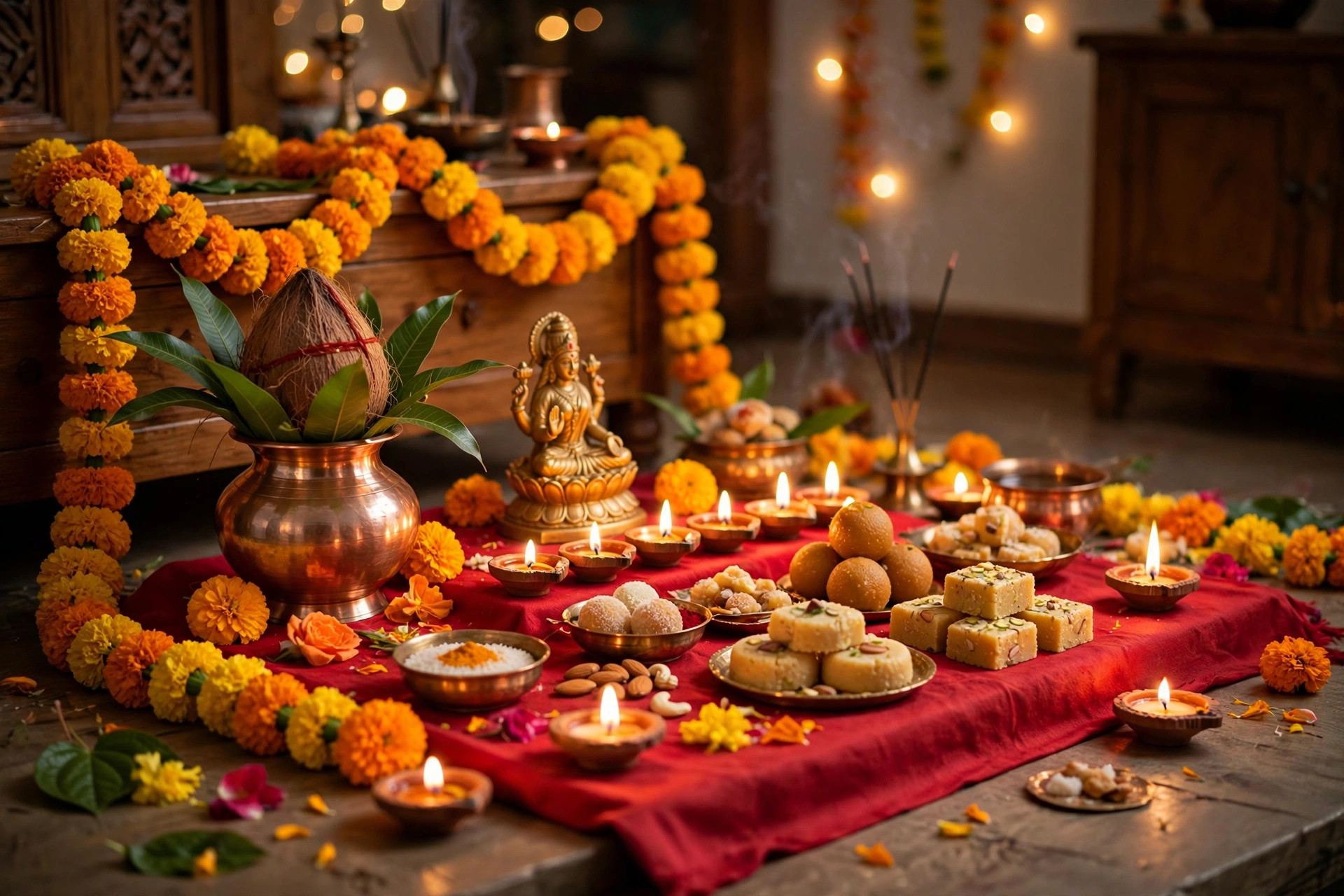
Lakshmi Puja on Diwali night is the heart of the festival for most Hindu families in India. After days of cleaning, decorating and shopping, the family gathers in the evening, lights the ghee lamp, worships Lakshmi and Ganesha together, and then lights diyas through the whole home. It is a beautiful ritual, but for first time hosts, or for families doing it in a new home, it can feel confusing. What do you actually need, in what order does the puja happen, and what if you do not have every item on a long list?
This guide answers all of that in plain language. You will find a full samagri list with easy alternatives, a step by step vidhi you can follow at home without a priest, a short 20 minute version for busy families, and practical tips for apartments, children and different regions. Your own family custom always comes first: if your family does something differently, follow your tradition. This guide is a clear starting point, not a replacement for it.
Diwali Lakshmi Puja 2026 is on Sunday 8 November, in the evening Pradosh Kaal after sunset. Exact muhurat times differ by city, so check your local panchang or a trusted city wise muhurat page before the day, and set up the altar before sunset so you are ready when the muhurat begins.
When and Where to Do Lakshmi Puja
Lakshmi Puja is done on the Amavasya night of Diwali, in Pradosh Kaal, the period just after sunset. In 2026, many Delhi timings are reported around 5:55 PM to 7:50 PM, but timings shift by a few minutes in other cities, so use your own city’s time rather than converting another city’s time.
Choose a clean spot, ideally in the north east or east part of your home, or in your pooja room. Place a low wooden chowki or a clean table, cover it with a red or yellow cloth, and sit facing east or north if possible. The Lakshmi idol or picture should face east or north as well, and Ganesha is placed to Lakshmi’s right in many homes. If space is tight, a clean corner shelf works just as well, as long as it is clean, stable and free from clutter.
In the morning, clean the home, especially the entrance and the pooja space. Use easy Diwali rangoli designs at the door, hang a toran of mango leaves or marigold flowers, and keep diyas ready for the evening. These preparations are part of the welcome for Lakshmi, and they make the evening feel calm rather than rushed.
Lakshmi Puja Samagri List
You do not need every item on a long list. The essentials are marked below, and the rest depends on your family custom and what is available near you.
Deities and altar, essentials
- Lakshmi and Ganesha idols or a framed picture: essential. Clay, metal or a picture all work, and a new Diwali picture is common.
- Low stool or clean table, covered with a red or yellow cloth: essential.
- Rice or wheat grains: a small heap on the cloth, optional, used as a bed for the kalash in some homes.
Kalash, essentials
- Kalash, a copper, brass, clay or clean steel pot filled with water: essential. A steel lota works if you do not have a traditional kalash.
- Mango leaves, ideally 5, placed at the mouth: betel leaves or clean green leaves are fine alternatives.
- Coconut with husk, tied with red thread: placed on top of the kalash.
- Coin, supari, haldi and akshata: dropped into the kalash.
Flowers, leaves and fragrance
- Fresh flowers, especially marigold and rose garlands: essential in the sense that some fresh flowers should be offered, even if you have only one bunch.
- Lotus, if available: Lakshmi’s flower, but rose or marigold are fine substitutes.
- Durva grass for Ganesha: optional, a few blades from a clean lawn.
- Incense sticks or dhoop, and camphor for the aarti: one stick is enough, especially in apartments with sensitive smoke alarms.
Kumkum, haldi and akshata
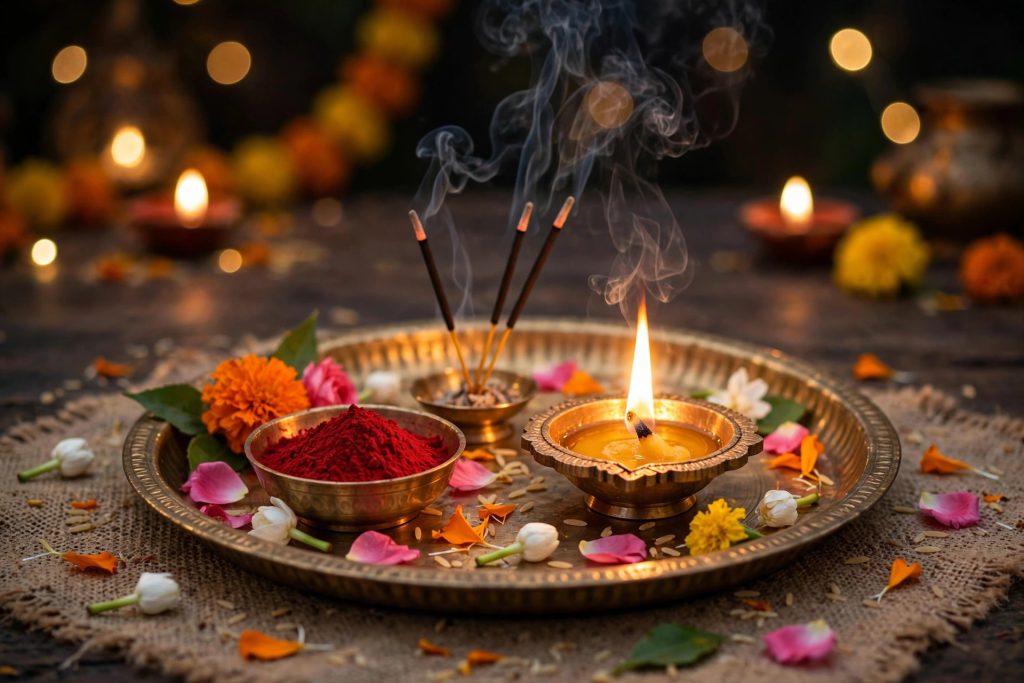
- Kumkum or roli, haldi and akshata, which is unbroken rice mixed with kumkum: essential, and easy to make at home.
- Chandan paste or powder mixed with water: optional.
- Small bowls and a puja thali to hold everything: any clean plates work.
Lamps, sweets and offerings
- Main ghee lamp, the akhand diya: essential. Use ghee for the main lamp, and mustard or sesame oil for other diyas if ghee is short.
- Clay diyas, 11, 21 or more: light as many as you can manage safely, and use LED diyas for the rest of the home if needed.
- Cotton wicks, matches and a bell: keep matches away from children.
- Sweets and fruits for naivedyam: kheer, ladoo, kaju katli or any home made sweet, plus bananas, apples or pomegranate. Kheel and batashe, puffed rice and sugar drops, are traditional in North India.
- Panchamrit, made from milk, curd, ghee, honey and sugar, or simply milk: used for bathing the idols or as an offering.
- Coins, jewellery and account books: worshipped in many business families, especially in Gujarat and Maharashtra, as part of Chopda Puja. Skip this if it is not your custom.
The 10 item essentials list, if you are short of time
If it is Diwali afternoon and you have not bought everything, these 10 items are enough for a complete home puja: a Lakshmi Ganesha picture, a clean cloth, a steel or copper lota as kalash with a coconut, kumkum, turmeric and rice, one bunch of flowers, a ghee lamp and a few diyas, incense and camphor, one sweet and some fruit, a few coins, and matches. A simple, clean puja done with devotion is complete.
Step by Step Lakshmi Puja Vidhi at Home
Follow these steps in order. Take your time, and involve children by giving them small jobs, like arranging flowers, holding the bell or lighting diyas with an adult.
Step 1: Prepare in the day
Clean the home and the puja space, draw a rangoli at the entrance, and place a diya there. Bathe and wear clean or new clothes, ideally in red, yellow or orange. Set up the altar, kalash and all items before the muhurat, so you are not searching for things during the puja.
Step 2: Set the altar
Place the cloth on the chowki, set the kalash on a small heap of rice on the right side as you face the altar, and place Ganesha and Lakshmi on the cloth, Ganesha to Lakshmi’s right in many homes. Keep coins, account books and naivedyam ready, along with the puja thali.
Step 3: Achamana and sankalpa
When the muhurat begins, light the main ghee lamp and sit facing the altar. Sip a little water three times for purification, then take a little water and rice in your right hand and state your sankalpa: your name, the day, and your intention to worship Lakshmi and Ganesha for the wellbeing of the family. Let the water fall into a small plate.
Step 4: Worship Ganesha first
Every puja starts with Ganesha, the remover of obstacles. Offer kumkum, akshata, durva and a flower, and chant Om Gan Ganapataye Namah. Offer a sweet, traditionally modak if you have it, or any sweet you have prepared.
Step 5: Kalash puja
Apply kumkum to the kalash, offer akshata and a flower, and remember that the kalash represents fullness and the presence of the deities. Keep it steady and on a plate, so water does not spill on the cloth.
Step 6: Invite and worship Lakshmi
Invoke Lakshmi with a flower offered at the idol’s feet, then offer the shodashopachara, the sixteen offerings, or a simple version of them: a seat, water for the feet and hands, a bath with a few drops of water or panchamrit, cloth, fragrance, akshata, flowers, incense, lamp and food. If you bathe a metal idol, use panchamrit and then clean water, and dry it gently. For a framed picture, offer flowers and akshata instead of a bath.
Step 7: Worship wealth symbols, if this is your custom
Offer flowers and kumkum to coins, jewellery, account books or your laptop ledger, if your family observes Chopda Puja. Write Shubh and Labh or a swastika on the first page of a new account book with kumkum or a red pen, where this is customary.
Step 8: Mantras and stotra
Chant the Lakshmi mantra Om Shreem Mahalakshmyai Namah 11 or 108 times, or as many times as you can with focus. If you know it, recite the Mahalakshmi Ashtakam or Sri Suktam. Children can join by chanting along or by ringing the bell softly. The point is attention and devotion, not speed or a perfect count.
Step 9: Aarti and pushpanjali
Perform the aarti with camphor or a ghee lamp, waving it clockwise while the family sings the Lakshmi aarti and the Ganesha aarti together. Then offer flowers with folded hands, ask forgiveness for any mistakes in the puja, and share the prasad with everyone present, including neighbours and household help if that is your custom.
Step 10: Light diyas through the home
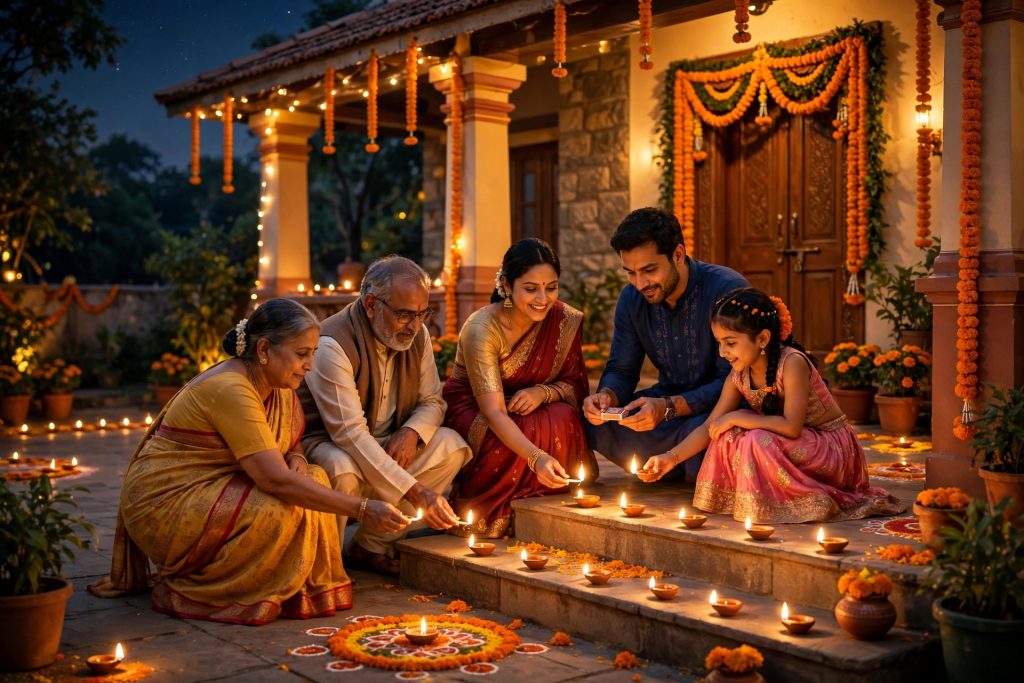
After the puja, light diyas at the doorway, windows, balcony, kitchen and tulsi plant, to welcome Lakshmi into a bright home. Many families keep one lamp burning safely through the night, on a metal plate away from curtains. For safety tips on diyas, curtains and children, see our Diwali safety tips at home guide, and for pooja room styling see our Diwali pooja room decoration ideas.
The 20 Minute Vidhi for Busy Families
If you are short of time, or if elderly family members cannot sit for long, use this shorter version. It keeps the essential order intact.
- 0 to 3 minutes: light the main lamp, do achamana and sankalpa, and worship Ganesha with kumkum, a flower and a sweet.
- 3 to 10 minutes: offer flowers, akshata, incense and naivedyam to Lakshmi, and chant Om Shreem Mahalakshmyai Namah 11 times.
- 10 to 15 minutes: perform aarti with camphor, sing the Lakshmi aarti, and offer flowers with folded hands.
- 15 to 20 minutes: share prasad, and light diyas at the door and windows with the family.
This version is complete for a home puja. Do not feel guilty for keeping it short: a calm, focused 20 minute puja is better than a rushed, stressful hour.
Regional Differences to Know
Customs differ by region, and your family tradition comes first. In Bengal, Odisha and Assam, many households observe Kali Puja on Diwali night, while Lakshmi Puja is done earlier, on Kojagari Purnima. In Gujarat and Rajasthan, Chopda Puja and Lakshmi footprints at the entrance are common. In Maharashtra, coins and jewellery are worshipped with Lakshmi, and dhane gul, coriander seeds and jaggery, is offered in some families. In Telugu and Kannada homes, the morning oil bath on Naraka Chaturdashi is central, with evening deepalu for Lakshmi. In Tamil homes, Deepavali centres on the dawn oil bath and new clothes, with some families doing Lakshmi Kubera puja in the evening. In Punjab, Diwali also marks Bandi Chhor Divas for Sikh families, while many Hindu Punjabi homes do Lakshmi Ganesha puja with diyas.
If your family follows a regional custom not listed here, keep it. Add the steps above around it, rather than replacing your tradition with a generic list.
Apartment, Safety and Kids Tips
In apartments, fire safety and smoke alarms need extra care. Keep one real lamp on a metal plate during the puja, and use LED diyas for the rest of the evening. Use one incense stick near an open window, or skip incense if alarms are sensitive. Keep lit diyas away from curtains, paper decorations and children, and never leave a flame unattended.
Give children a job: lighting diyas with an adult, arranging flowers, drawing a small rangoli, or ringing the bell during aarti. This keeps them involved and away from boredom near flames. For families abroad, Indian grocery stores and temple shops stock kumkum, camphor, wicks and Diwali pictures, but order online a week early if you live far from a store, and use your own city’s muhurat time rather than converting Indian times.
Common Mistakes to Avoid
- Starting late: set up the altar before sunset, so you are ready when Pradosh Kaal begins.
- Forgetting Ganesha: Ganesha is always worshipped first, before Lakshmi.
- Using a broken or chipped idol or lamp: replace it, or use a picture instead.
- Leaving lamps unattended near curtains, paper decorations or children.
- Buying more than you need: a simple, clean puja is complete, and fresh flowers and natural colours are better for the home and the earth than plastic flowers and synthetic colours.
- Rushing mantras to hit a count: chant slowly, even if you do fewer repetitions.
Conclusion
Lakshmi Puja at home does not need a priest, a long shopping list or a perfect performance. Clean the home, set a simple altar, worship Ganesha first, invite Lakshmi with flowers and light, chant with attention, perform aarti together, and light diyas through the home. Whether you follow the full vidhi or the 20 minute version, the heart of the puja is the same: a clean, bright home, a family gathered together, and gratitude for the year gone by. This Diwali, on Sunday 8 November, light the lamp a little early, sit together without rushing, and let the evening end with prasad, diyas and the people you love.
Frequently Asked Questions
When is Lakshmi Puja on Diwali 2026?
Lakshmi Puja 2026 is on Sunday 8 November, in the evening Pradosh Kaal after sunset. Exact muhurat times differ by city, so check your local panchang for your city’s time.
What are the essential items for Lakshmi Puja at home?
The essentials are a Lakshmi and Ganesha picture or idol, a clean cloth, a kalash of water with mango leaves and a coconut, kumkum, turmeric and akshata, fresh flowers, a ghee lamp and diyas, incense and camphor, a sweet and fruit as naivedyam, and a few coins. Everything else is optional.
Can I do Lakshmi Puja without a priest?
Yes. Many families perform a simple Lakshmi Ganesha puja at home without a priest: sankalpa, Ganesha first, then Lakshmi, offerings, a mantra or stotra, aarti and lighting lamps. Sincerity matters more than an elaborate list.
How should Lakshmi and Ganesha be placed on the altar?
Place them on a clean cloth on a low stool, ideally facing east or north, with Ganesha to Lakshmi’s right in many homes. Sit facing east or north if possible, and keep the kalash steady on the right side as you face the altar.
Can I do a short Lakshmi Puja if I am busy?
Yes. A focused 20 minute puja is complete: Ganesha worship, Lakshmi offerings and mantra, aarti, prasad and lighting diyas. Keep the order the same, chant slowly, and do not rush to cover every optional item.

1 Comment
Pingback: Dhanteras Puja Vidhi at Home (2026): Step by Step Guide, Samagri List and Shubh Muhurat Tips