

Introduction
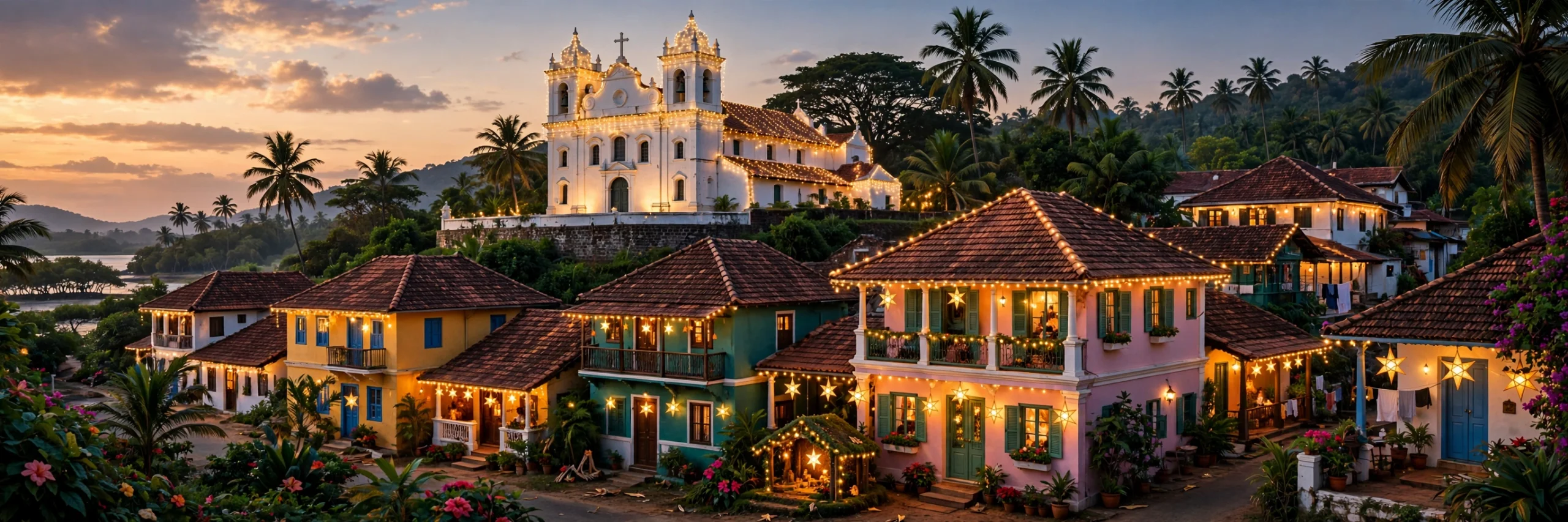
Christmas in India is one of the most joyful festivals. Although Christians form only a small part of the population, the festival has grown far beyond any one community. By December, streets glow with stars and fairy lights, bakeries fill with the smell of plum cake, and families of every faith gather to celebrate together.
This guide covers its history, regional traditions, food, decorations, and ideas for celebrating at home in 2026.
A Brief History of Christmas in India
Christianity reached India long before it spread through most of Europe. According to tradition, St Thomas the Apostle arrived on the Malabar Coast in 52 CE and began preaching in what is now Kerala. The Saint Thomas Christian community that grew from his work has kept its faith alive for nearly two thousand years.
A second chapter began in the sixteenth century, when Portuguese traders and missionaries settled in Goa. They introduced Midnight Mass, cribs, carols, and festive baking. Goa’s famous Christmas sweets, known collectively as kuswar, and its love of plum cake trace back to this period.
The British era added roast dinners, plum puddings, and decorated trees, which Indian families adopted and blended with their own customs.
Who Celebrates Christmas in India
Christians make up about 2.3 percent of India’s population, around 28 million people, with the largest communities in Kerala, Goa, Nagaland, Mizoram, Meghalaya, Tamil Nadu, and parts of the Northeast. For these families, Christmas is the most important festival of the year, centred on church, prayer, and family.
But Christmas in India belongs to far more people than its Christian community. In most Indian cities, Hindus, Muslims, Sikhs, Jains, and people of no particular faith celebrate it with enthusiasm. Schools hold Christmas celebrations, offices organise Secret Santa exchanges, and neighbours exchange cake and sweets regardless of religion.
Midnight Mass, Carols and Cribs
Christmas in India begins on Christmas Eve, 24 December, with Midnight Mass. Churches across the country fill up as families arrive dressed in their finest clothes. The service usually starts around 11 pm and runs past midnight, with hymns, carols, and readings marking the birth of Christ.
Carol singing is one of the most loved traditions of the season. In the weeks before Christmas, groups of children and adults go from house to house in their neighbourhoods, singing carols and collecting small gifts or money.
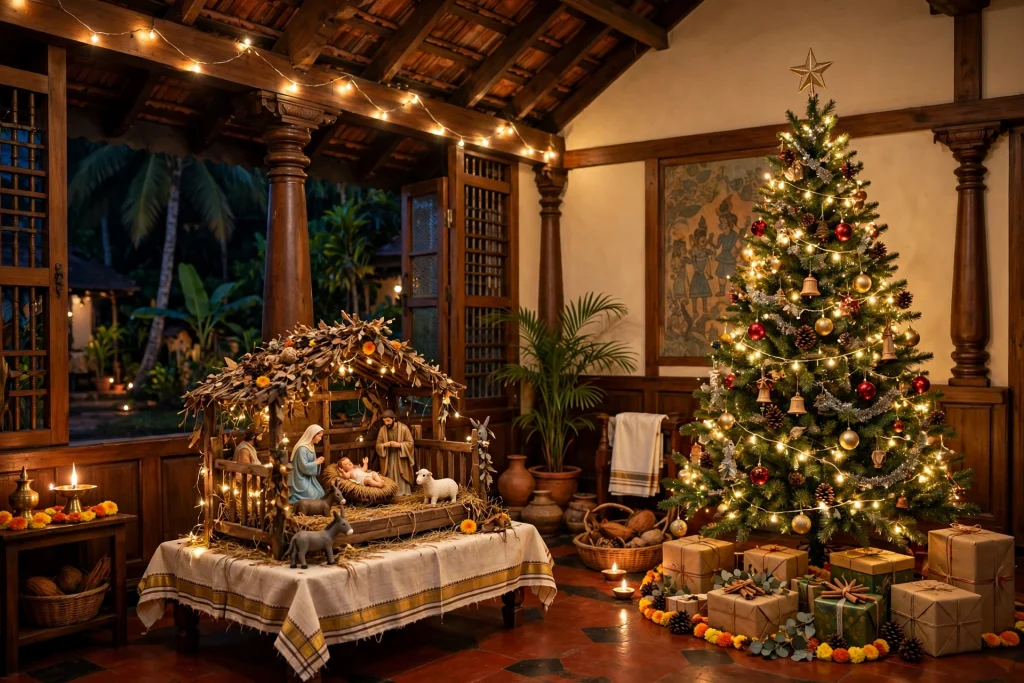
The crib, a nativity scene showing the birth of Jesus, is another central tradition. Families build cribs at home from clay or wooden figures, often adding miniature coconut palms and village houses, and some spend weeks on elaborate versions with lights and moving figures.
Christmas in Goa
Goa is the heart of Christmas in India. The Portuguese influence is still visible everywhere, in the whitewashed churches, the colonial architecture, and the festive food.
The centrepiece of Goan Christmas is the Missa de Galo, the Midnight Mass held on Christmas Eve. Families attend Mass together, then return home for a feast that often continues into the early hours, while churches glow with lights and stars.
Food is central to the celebration. In the weeks before Christmas, Goan households prepare kuswar, a spread of traditional sweets that includes bebinca, dodol, kulkuls, nevris, and bolinhos, shared with neighbours and guests. Plum cake is baked in large quantities and exchanged as gifts.
Christmas in Kerala
Kerala’s Christmas is one of the oldest in India, and it is also one of the most distinctive. The state has the largest Christian population in the country, and the festival is celebrated with deep devotion and great warmth.
Many Kerala Christian families observe a 25-day fast called Nombu before Christmas, eating simple vegetarian meals and attending daily prayers, ending with a feast after Midnight Mass on Christmas Eve.
Kerala is also the home of the first Christmas cake in India. A British planter named Mambally Bapu, from Thalassery, baked the first plum cake in the country in 1883, and Kerala’s bakeries now produce plum cakes by the thousands every December.
A much-loved Kerala figure is Christmas Appooppan, or Christmas Grandfather, the local version of Santa Claus, who visits homes and churches before Christmas to hand out sweets to children. Kerala homes are also famous for elaborate cribs and large illuminated stars hanging from rooftops and trees.
Christmas in Kolkata
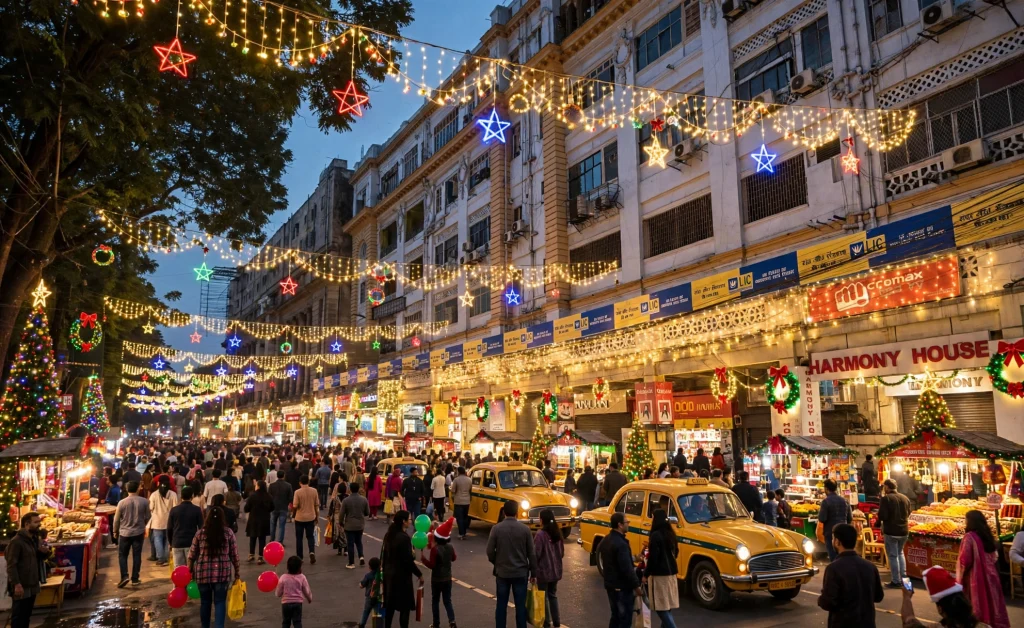
Kolkata hosts one of the most spectacular public Christmas celebrations in India. The centre of it all is Park Street, the city’s famous dining and entertainment strip, which is transformed every December into a glowing wonderland of lights, decorations, and crowds.
The Kolkata Christmas Festival runs through the season, with live music, food stalls, and performances along Park Street and in nearby Allen Park, drawing families from across the city.
Food is a big part of the experience. Flurys, the legendary Park Street bakery, is famous for its Christmas cakes, puddings, and pastries, and queues form outside its doors in December. Nahoum, the Jewish bakery in the New Market area, is known for its rich fruit cakes and traditional baked goods. Another treasure is Bow Barracks, a small Anglo-Indian neighbourhood that becomes a Christmas village every December, with decorated homes and stalls selling homemade cakes and wine.
Christmas in Mumbai
Mumbai celebrates Christmas with the energy of a city that never sleeps. The city’s large East Indian and Goan Christian communities, concentrated in areas like Bandra, Hill Road, and parts of South Mumbai, lead the celebrations.
Bandra is the heart of Mumbai’s Christmas. Its churches, including the Basilica of Our Lady of the Mount and St Andrew’s Church, are beautifully decorated, and the streets around them fill with lights, stars, and nativity displays.
Bakeries in Bandra and Colaba sell plum cakes, marzipan, and traditional sweets, and many Goan and East Indian families prepare sorpotel, vindaloo, and fugias. Markets like Crawford Market and Linking Road sell decorations, lights, and trees, and the crowds grow bigger as Christmas Day approaches.
Christmas in the Northeast
The Northeast of India celebrates Christmas with unmatched enthusiasm. Nagaland, Mizoram, and Meghalaya have large Christian populations, and in some districts the festival is the biggest event of the year.
In Nagaland, Christmas is celebrated across the state, with churches decorated in lights and families gathering for feasts and community celebrations. The season coincides with the famous Hornbill Festival, which runs 1-10 December and showcases Naga culture, music, food, and crafts. Visitors who come for the Hornbill Festival often stay on for Christmas.
In Mizoram, church services are central, carol groups perform in public squares and churches, and community feasts are common.
Meghalaya, and especially its capital Shillong, is another Christmas hotspot. Known as the Scotland of the East, Shillong lights up in December with decorated churches, Christmas trees in public squares, and a thriving market for festive food and decorations.
Christmas in Delhi and North India
In Delhi and the rest of North India, Christmas is celebrated with enthusiasm even though the Christian population is smaller than in the south or the Northeast. The capital’s churches, including the Cathedral Church of the Redemption and the Sacred Heart Cathedral, hold beautiful Midnight Mass services that attract large congregations.
Delhi’s Christmas is also a shopping and social season. Malls put up large trees and decorations, Christmas markets sell handicrafts and festive food, and restaurants offer special Christmas menus.
In North Indian homes, Christmas is often a family occasion rather than a religious one. Families decorate a tree, exchange gifts, bake cakes, and host dinners for friends, and schools and offices organise Christmas parties.
Christmas Decorations in Indian Homes
The Christmas star is the most iconic decoration, a large illuminated star that hangs outside homes, churches, and shops. In Kerala and Goa, handmade paper stars in bright colours are a traditional craft, and many families make their own each year.
Christmas trees in India come in many forms. While artificial fir trees are common in cities, many families use what is available locally. In Kerala and parts of the South, banana and mango trees are decorated with lights and ornaments, and potted plants and even coconut palms are dressed up as Christmas trees.
Lights are everywhere. Strings of fairy lights outline rooftops, windows, and balconies, and whole streets glow in the evenings, while inside the home families set up the crib, hang stockings, and decorate with candles, tinsel, and ornaments. If you are planning your own decorations, these Christmas decor ideas for Indian homes offer practical inspiration for every room and budget.
Christmas Food in India
Food is the heart of Christmas in India. The Christmas feast usually follows Midnight Mass on Christmas Eve or is served as a grand lunch on Christmas Day.
| Dish | Region | What It Is |
|---|---|---|
| Plum cake | Goa, Kerala, Kolkata | Rich fruit cake with dried fruit, nuts, and spices, soaked for weeks |
| Kuswar | Goa | A spread of traditional sweets including bebinca, kulkuls, and nevris |
| Appam and stew | Kerala | Lacy rice pancakes served with a mild coconut milk chicken or vegetable stew |
| Biryani | Hyderabad, Mumbai | Festive rice dish served at Christmas lunches in many Christian homes |
| Dodol | Goa, Kerala | A dark, chewy sweet made from coconut milk, jaggery, and rice flour |
| Bebinca | Goa | A layered egg and coconut milk pudding, the queen of Goan desserts |
Beyond these classics, Goan homes serve sorpotel and vindaloo, Kerala families prepare duck roast and meen moilee, and Anglo-Indian households offer roast chicken, cutlets, and Christmas pudding. For a full festive menu plan, see this Indian Christmas menu for 2026 with dishes for every course.
Gifts and Secret Santa
Children hang stockings and wait for Santa, or Christmas Appooppan, to fill them with sweets and small toys. Families exchange gifts on Christmas morning, and friends swap presents at parties throughout the season.
Secret Santa has become hugely popular in India, especially in offices, schools, and friend groups. Participants draw names in advance, buy a gift within an agreed budget, and reveal themselves at a Christmas party. Popular gifts include plum cakes, candles, plants, books, and hampers.
How to Celebrate Christmas at Home as a Non-Christian Family
You do not need to be Christian to enjoy Christmas in India. Start with decorations: put up a tree, hang a star outside your home, and string fairy lights around your windows. Involve the children in making paper stars and ornaments, and set up a small crib together as a craft project.
Host a gathering. Christmas is a wonderful excuse to invite friends and neighbours over for an evening of food and conversation, with cake, snacks, and hot chocolate or a full festive meal. If you need a plan, this guide on how to host a Christmas party at home in India covers menus, decorations, and games.
Plan activities for children: bake plum cake or cookies together, make Christmas cards, watch a festive film, or organise a small Secret Santa within the family. Then visit the celebrations around you: walk through a decorated street, visit a church crib display, or explore a Christmas market.
Christmas Markets and Shopping
Christmas markets are a growing tradition in India. In Kolkata, the Christmas Festival on Park Street combines food stalls, live music, and craft sellers, and in Goa, church fairs and village markets sell sweets, decorations, and handmade goods.
In Mumbai, Delhi, and Bengaluru, malls and pop-up markets host Christmas bazaars selling ornaments, candles, cakes, and hampers, with handmade stars, wreaths, and nativity figures from local artisans. Start shopping in early December, since the best handmade stars and cribs sell out quickly and popular bakeries take advance orders for plum cakes.
Christmas 2026 Season Dates Calendar
Planning your celebrations is easier when you know the key dates. Here is the Christmas 2026 calendar for India.
- Advent begins: Sunday, 29 November 2026. Advent is the four-week season of preparation before Christmas.
- Christmas Eve: Thursday, 24 December 2026. Midnight Mass is held in churches across India, usually starting around 11 pm.
- Christmas Day: Friday, 25 December 2026. A public holiday across India, celebrated with family gatherings, feasts, and gift-giving.
- Boxing Day: Saturday, 26 December 2026. A quieter day for family visits, observed mainly in Anglo-Indian and Goan communities.
- New Year’s Eve: Thursday, 31 December 2026. Churches hold watch-night services, and parties mark the end of the year.
- Epiphany: Wednesday, 6 January 2027. The feast marking the visit of the Magi.
Frequently Asked Questions
Is Christmas a public holiday in India?
Yes, Christmas Day, 25 December, is a gazetted public holiday across India. Government offices, schools, and banks are closed, and most private offices also give the day off.
How do non-Christians celebrate Christmas in India?
Many non-Christian families celebrate Christmas as a cultural and social festival. They decorate their homes, put up trees, exchange gifts, bake cakes, and host parties for friends and neighbours.
What is the most famous Christmas celebration in India?
Goa is often called the home of Christmas in India because of its Portuguese heritage, Midnight Mass, and kuswar sweets. Kolkata’s Park Street Christmas Festival is the most spectacular public celebration. Kerala’s Christmas is the oldest, with traditions dating back to St Thomas in 52 CE.
What food is eaten at Christmas in India?
Plum cake is universal, and Goan homes serve kuswar sweets, sorpotel, and vindaloo. Kerala families prepare appam and stew, duck roast, and bebinca. Kolkata is famous for its bakery cakes from Flurys and Nahoum.
When does the Christmas season start in India?
The season begins with Advent, which starts on 29 November 2026. Decorations and markets appear from the first week of December, and the main celebrations run from Christmas Eve on 24 December through to New Year and Epiphany on 6 January.
Conclusion
Christmas in India is a festival that belongs to everyone. From the Midnight Masses of Goa and Kerala to the lights of Park Street in Kolkata and the Hornbill Festival in Nagaland, the season brings together faith, food, music, and community. Whether you attend Midnight Mass, bake a plum cake, or walk through a decorated street with your family, there is something for everyone.

1 Comment
Pingback: How to Celebrate Christmas on a Budget in India (2026): A Complete Plan Under Rs 5,000