

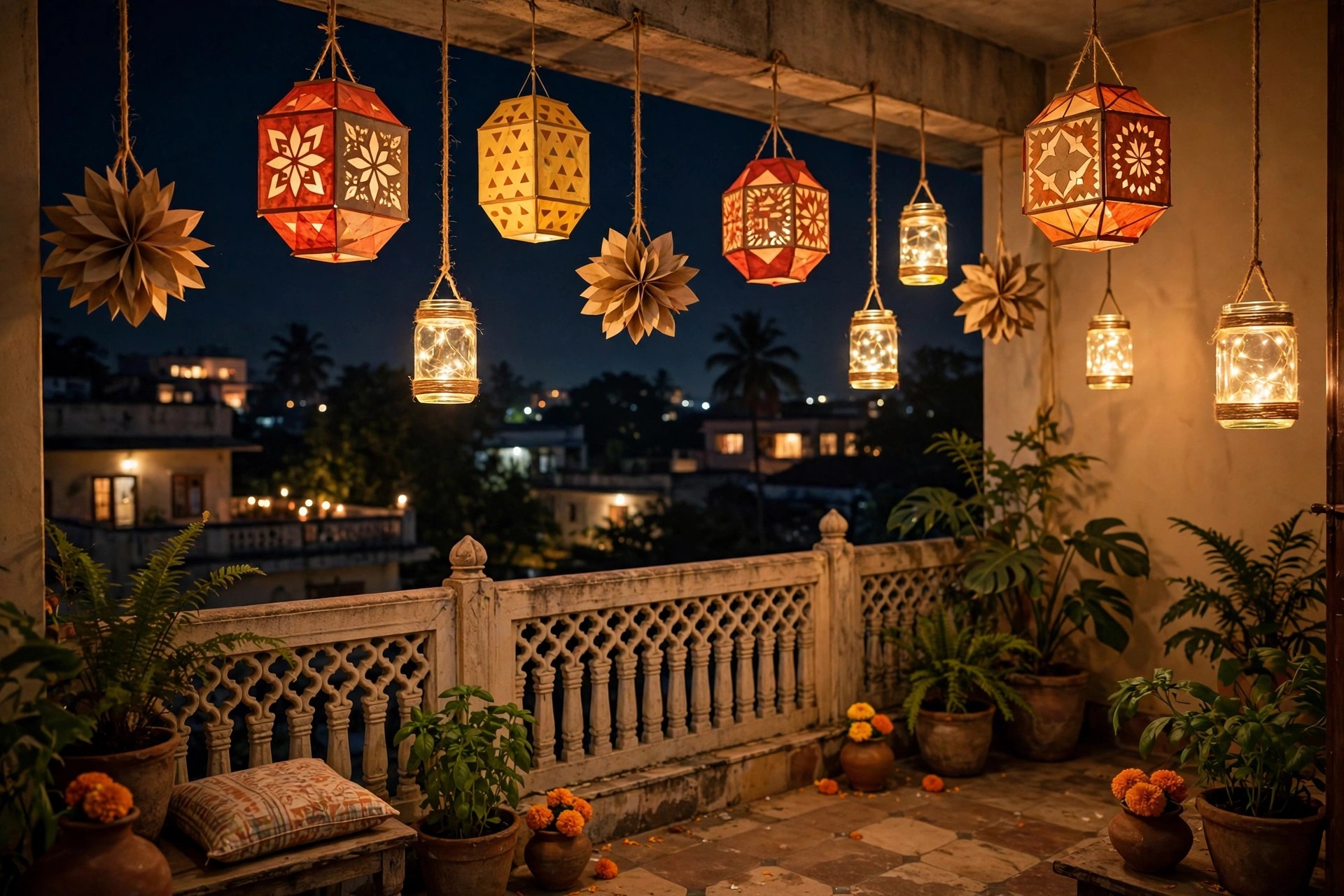
A Diwali lantern does something no other decoration quite does: it turns light into a shape. Diyas glow low, fairy lights sparkle in a line, but a lantern holds light inside a form, a star, a cylinder, a jar, and throws patterned shadows across a wall, a balcony or a doorway. That is why lanterns photograph so well, and why children remember them long after the festival ends.
This guide gives you 12 DIY Diwali lanterns and jar lights you can make at home, with step-by-step instructions, materials, costs and safety notes for flats, balconies and homes with children and pets. It is different from a general decoration list: every idea here is a lantern you build, not a lantern you buy, and every idea tells you how to hang it without drilling, how to light it safely, and how long it will last. Pair it with our DIY Diwali toran ideas for the entrance, our Diwali balcony decoration ideas for outdoor placement, and our Diwali safety tips at home before you light anything with a real flame.
Before You Start: Light, Safety and Hanging
Choose your light source before you choose your lantern design, because it decides what is safe.
LED fairy lights and LED tealights: The safest choice for paper lanterns, children’s rooms, balconies and any lantern near curtains or fabric. They give steady light, they do not heat paper, and they run for hours on a small battery pack. Use warm white LEDs for a Diwali glow, not bright white, which looks cold.
Real diyas and candles: Beautiful, but only inside glass, metal or clay lanterns, on a stable tray, away from fabric, and never inside a paper lantern. A paper lantern with a real flame is a fire risk, however careful you are, and it is not worth it when LED lights look just as warm in a photograph.
Solar lights: A good option for balconies and gardens if the lantern will be outside all day. Charge the panel in sunlight, and the lantern will glow after sunset without wires or batteries.
For hanging, rented flats and modern homes need damage-free options: removable adhesive hooks rated for the lantern’s weight, curtain rods, balcony rail hooks, and S-hooks over door frames. Test each hook with the finished lantern before Diwali night, because a paper lantern full of lights is heavier than an empty paper lantern, and a hook that holds in the afternoon may fail when the lantern swings in a breeze. Keep lanterns at least 30 cm away from curtains, and never hang a lantern with a real flame where wind can push it into fabric.
Paper Lanterns: The Classic Kandeel
Paper lanterns are the most traditional Diwali lantern, and they are also the cheapest and most forgiving to make. Use coloured chart paper, tissue paper or old wrapping paper, and always use LED lights inside.
1. Classic star kandeel
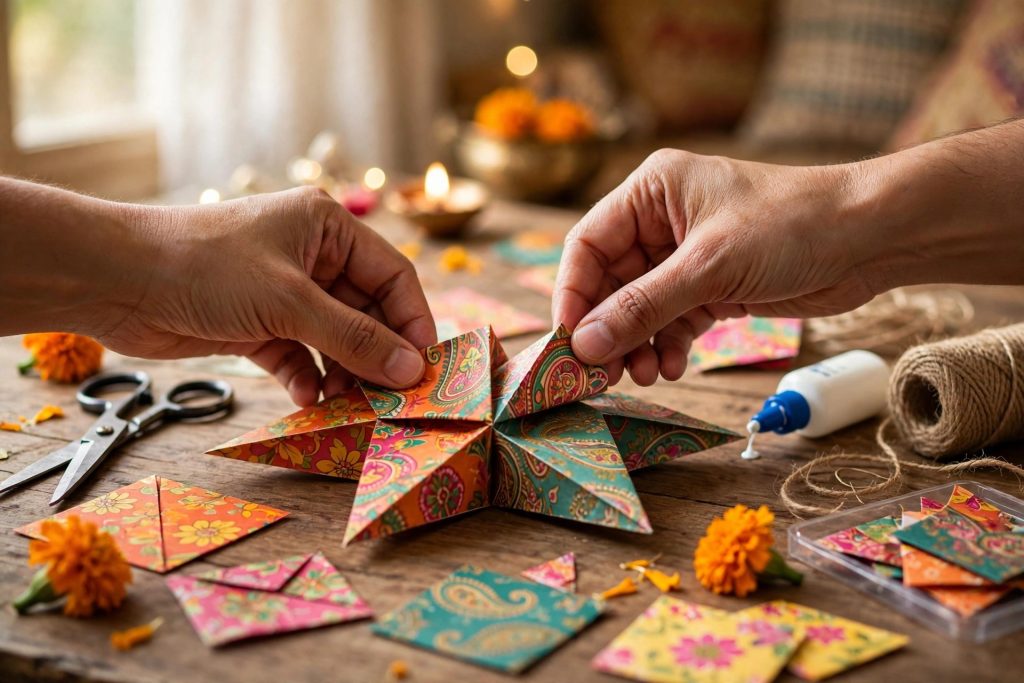
Cut two identical star shapes from chart paper, score and fold each point, glue the stars back to back around a frame of thin cardboard strips, and add a tassel at the bottom. This is the lantern most Indian homes grew up with, and it looks best in deep red, orange or magenta with gold trim. Time: about 1 hour. Cost: under Rs 100, plus LED lights.
2. Cylinder paper lantern
Roll a sheet of coloured paper into a cylinder, cut vertical slits around the middle without cutting through the top and bottom edges, and gently push the ends together so the slits bow outward. Add a paper rim at top and bottom, a string handle, and a battery LED inside. This is the easiest lantern for beginners and children, because there is no complex folding, and it takes about 20 minutes.
3. Tissue paper pompom lantern
Layer 8 to 10 sheets of tissue paper, fold them like a fan, tie the centre with wire, round the ends, and gently pull the layers apart into a ball. Hang it with a LED fairy light inside, or cluster three pompoms at different heights in a doorway. Tissue pompoms are light, so they hang well from a single adhesive hook, but they crush easily, so make them the day before Diwali, not a week ahead.
4. Paper fan lantern
Fold coloured paper into fans, join 4 to 6 fans into a circle, and glue a LED tealight holder in the centre, behind a small paper disc that diffuses the light. Paper fan lanterns look modern, they suit flats with little space, and they fold flat for storage, which is a real advantage if you have no storage room.
Glass Jar and Bottle Lanterns: Reuse What You Already Own
Glass jar lanterns are the best lantern for adults who want a beautiful result with no paper craft skills. They are sturdy, reusable, safe with LED lights, and they look expensive even when they cost almost nothing.
5. Mason jar fairy light lantern
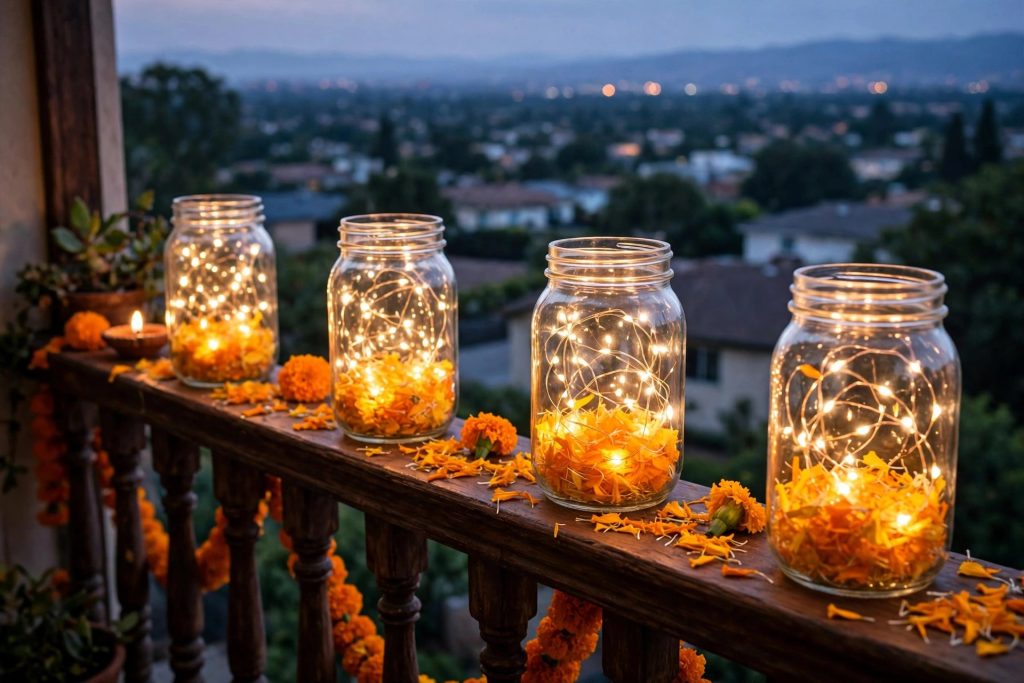
Clean a glass jar, place a short string of warm white fairy lights inside, and close the lid loosely or leave it open with the battery pack tucked behind the jar. Add a few dried flowers, a marigold petal or a small sprig of leaves inside for colour. Wrap twine around the neck and hang it from a hook, or line three jars along a balcony railing. This is the safest lantern for a windy balcony, because glass does not blow away, and the light is contained.
6. Painted jar diya holder
Paint the outside of a jar with glass paint or acrylic in a pattern of dots, leaves or a simple rangoli border, leaving small unpainted gaps where light can shine through. Place a LED tealight inside, not a real diya, unless the jar is wide, stable and on a tray away from fabric. Painted jars make good table lanterns, because the pattern throws soft shapes onto the tablecloth.
7. Glass bottle lantern
Use a clean glass bottle with a wide neck, push a string of fairy lights inside through the neck, and let the battery pack sit outside, hidden behind a plant or a curtain. Bottles in green, amber or blue glass give coloured light without coloured bulbs, and they are a good way to reuse bottles that would otherwise be thrown away. Do not cut glass at home unless you have the right tools and experience; a whole bottle with lights inside is safer and looks just as good.
8. Urli jar combination
Place a small glass jar lantern inside a larger brass or steel urli, surround it with water and floating petals, and add a second LED light in the urli itself. This combines two Diwali classics, the urli and the lantern, into one centrepiece for a dining table or an entrance table, and it is a good option if you have limited space for separate decorations.
Lanterns for Balconies, Gardens and Small Spaces
Outdoor lanterns need to survive wind, and indoor lanterns in small flats need to survive a lack of space. These ideas are designed for both problems.
9. Hanging cluster lanterns
Hang three lanterns at different heights from one hook or one curtain rod: one large, one medium and one small. Use lightweight paper or fabric lanterns, not glass, for a hanging cluster, because weight is the main risk. A cluster looks intentional, it fills a tall doorway or a balcony corner better than one large lantern, and it photographs beautifully against the night sky.
10. Balcony railing jar lights
Line glass jar lanterns along a balcony railing, wired or tied in place with twine so they cannot fall. Use solar fairy lights if the railing gets sunlight during the day, or battery lights with a timer, so you do not have to climb onto the railing every evening to switch them on. Keep jars away from plant leaves that could dry out near a light, and bring paper lanterns indoors if rain is forecast, because wet paper tears and sags.
11. Window lantern with a silhouette
Cut a simple silhouette, such as a diya, a star or a peacock shape, from black chart paper, stick it on the inside of a glass jar or a paper lantern frame, and place a LED light behind it. From outside, the window glows with a clear shape, which is especially effective in flats where the window is the main decoration visible from the street. This is also a good lantern for children to design themselves, because the silhouette is the creative part, and the rest is simple assembly.
12. Table lantern from a steel bowl
Turn a steel bowl upside down over a LED tealight, punch or drill small holes in a pattern if you have the tools, or simply place a pierced metal lantern you already own over a light. Metal lanterns throw the most beautiful patterned shadows of any lantern type, they are safe with LED lights, and they last for years, which makes them the best long-term investment in this list. If you do not want to punch metal at home, buy one plain metal lantern and decorate it with paint and tassels instead.
Costs, Time and Storage: A Quick Comparison
Paper kandeel lanterns cost under Rs 100 each and take 30 to 60 minutes, but they last one festival unless stored carefully in a box with tissue paper. Cylinder and fan lanterns cost even less and fold flat, so they are the best choice if storage space is tight.
Glass jar lanterns cost Rs 50 to Rs 200 each if you reuse jars, plus the cost of fairy lights, which can be reused for years. They take 10 to 20 minutes each, they last indefinitely, and they are the easiest lantern to make in bulk for a large balcony or a party.
Metal and bottle lanterns cost more upfront, Rs 200 to Rs 600, but they are the most durable, and they need almost no storage care beyond a wipe and a box. For a first Diwali in a new home, start with jars and one paper kandeel, and add metal lanterns over the next few years, rather than buying everything at once.
Store paper lanterns flat, in a labelled box, with tissue paper between layers, and store fairy lights untangled, wrapped around a piece of cardboard, so next Diwali starts with working lights, not a knot. Label the box with the year, because a lantern that looks perfect in storage may have faded, and you will want to know which ones to replace.
Safety Checklist Before Diwali Night
Use LED lights inside every paper, tissue and fabric lantern, without exception. Keep real flames only inside glass, metal or clay, on a stable tray, away from curtains, plants and children’s hands. Test every hook with the finished, weighted lantern, not with an empty one. Keep lanterns away from ceiling fans, because a swinging lantern near a fan blade is a hazard and a broken lantern. Switch off battery lights when you leave the house, and never leave a lit lantern unattended overnight, even if it is LED, because a battery pack can overheat if it is damaged. For pets, keep lanterns above head height and cords out of reach, because cats and dogs will bat at hanging tassels and chew on fairy light wires if they can reach them.
If a lantern falls, check it before relighting: a cracked jar, a torn paper lantern or a frayed wire should be retired, not repaired with tape and hope. Diwali is a festival of light, and the safest light is the one you can enjoy without watching it all evening.
FAQ
Can I put a real diya inside a paper Diwali lantern?
No, not safely. Paper, tissue and fabric lanterns should always use LED fairy lights or LED tealights. Real diyas and candles belong only inside glass, metal or clay lanterns, on a stable tray, away from fabric and wind.
How do I hang Diwali lanterns without drilling holes?
Use removable adhesive hooks rated for the lantern’s weight, curtain rods, balcony rail hooks, S-hooks over door frames, and twine tied to existing fixtures. Test each hook with the finished lantern, including lights and batteries, before Diwali night.
Which Diwali lantern is best for a small flat?
A cylinder paper lantern, a paper fan lantern, or a single glass jar lantern. All three are small, light, fold or store easily, and give a strong glow without crowding a room. Hang one in a window or doorway rather than filling every corner.
How long do homemade Diwali lanterns last?
Paper lanterns last one festival if stored flat with tissue paper, and often longer if they are not crushed. Glass jar and metal lanterns last for years, because only the lights and decorations need replacing. Fairy lights, stored untangled, usually last several festivals.
Are DIY lanterns safe for balconies in wind?
Glass jar lanterns tied to a railing are the safest balcony choice, because they do not blow away. Paper lanterns should be brought indoors in strong wind or rain, and any lantern with a real flame should not be used on a windy balcony at all.
What is the cheapest DIY Diwali lantern?
A cylinder paper lantern made from chart paper, or a reused glass jar with a short string of fairy lights. Both cost under Rs 100, take 20 minutes or less, and look festive with marigold petals or a simple tassel added.
Conclusion
A Diwali lantern is not just a decoration, it is a small piece of craft that holds light, and that is why it feels personal in a way shop-bought lights do not. Start with the light source, choose LED for paper and real flame only for glass or metal, hang without drilling, and test every hook before the festival night. Make one classic kandeel for tradition, one jar lantern for the balcony, and one silhouette lantern for the window, and you will have a home that glows from three places at once, without clutter, without risk, and without a large budget. Keep the best lanterns for next year, store the lights untangled, and let Diwali light, made by your own hands, be the part of the festival your family remembers.

2 Comments
Pingback: 12 DIY Diya Decoration Ideas for Diwali (2026): Painted, Mosaic and Floating Diyas
Pingback: 12 DIY Christmas Tree Decoration Ideas at Home in India (2026): Handmade Ornaments, Lights and Budget Styling